Tomioka Silk Mill and Silk Industry Heritage Sites | Comprehensive Explanation of Gunma Prefecture’s World Heritage
What is the Tomioka Silk Mill and Silk Industry Heritage Sites?
The “Tomioka Silk Mill and Silk Industry Heritage Sites” was officially registered as Japan’s 18th World Cultural Heritage at the 38th World Heritage Committee held on June 25, 2014. This heritage group consists of four cultural properties scattered throughout Gunma Prefecture, and conveys facilities and technologies that played important roles in Japan’s development as the world’s largest raw silk exporting nation from the late 19th century through the 20th century.
The Significance of World Heritage Registration
The primary reason this heritage group was recognized as a World Heritage site is that it demonstrates two universal values: the “technological innovation” that realized mass production of high-quality raw silk, which had long been produced in limited quantities, and the “technological exchange” that took place between the West and Japan. The International Council on Monuments and Sites (ICOMOS) recommended “registration” in April 2014 following an on-site survey, and formal registration was achieved through deliberation at the World Heritage Committee.
Japan’s mass production technology for raw silk, developed by Japan, spread silk—which once belonged only to the privileged classes of nobility and royalty—to people around the world, enriching their lives and cultures further. In an era when economic integration through world trade was advancing, this technological innovation made a significant contribution to the development of the international silk industry.
Details of the Four Component Assets
The Tomioka Silk Mill and Silk Industry Heritage Sites consist of four component assets that played different roles in both the sericulture technology needed for mass production of raw silk and the silk-reeling technology that supported increased cocoon production.
Tomioka Silk Mill (Tomioka City)
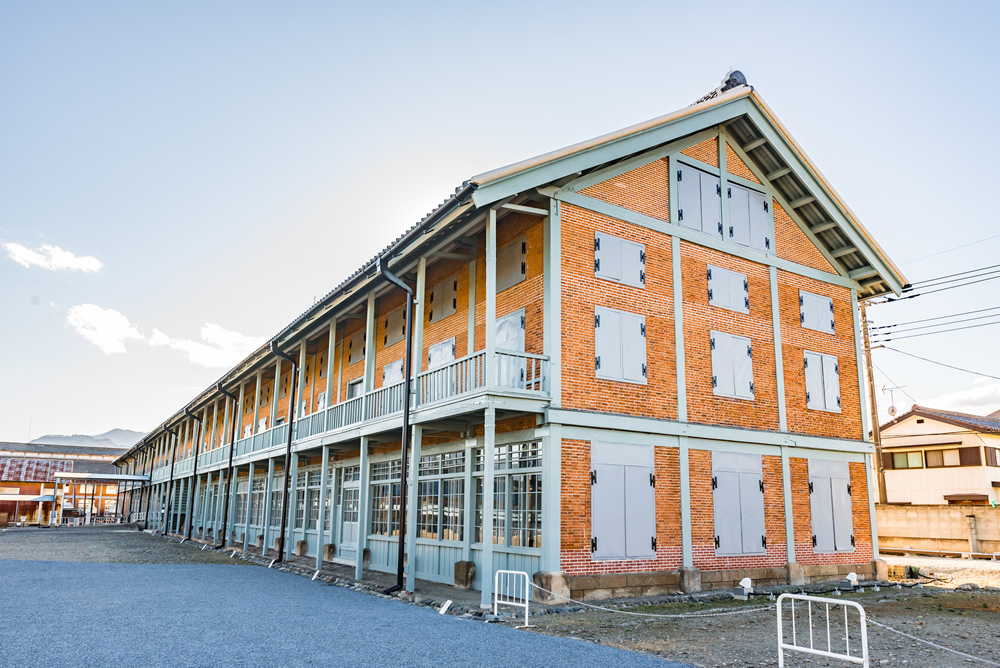
The Tomioka Silk Mill is a government-operated mechanical silk-reeling factory established by the Meiji government in 1872 (Meiji 5). To promote Japan’s modernization, it was constructed with the aim of introducing the latest silk-reeling technology from France and serving as a model for mechanical silk-reeling nationwide.
The building was constructed using wood-frame brick construction, the most advanced building technique of the time, and the main structures from the founding—including the silk-reeling workshop, east and west cocoon warehouses, and the inspector’s residence—remain in good condition today. The silk-reeling workshop in particular boasted a massive space of approximately 140 meters in length and approximately 12 meters in width, making it one of the world’s largest facilities of its kind.
Under the guidance of French engineer Paul Brunat, the mill developed raw silk mass-production technology that incorporated foreign techniques while adapting to Japanese conditions, exerting great influence on the development of silk-reeling industries nationwide. The government-operated period lasted until 1893, after which it was transferred to private ownership and continued operations until 1987, leading Japan’s silk-reeling industry for 115 years.
Tajima Yasohei’s Former Residence (Isesaki City)
Tajima Yasohei’s Former Residence is a dwelling and sericulture chamber built in 1863 (Bunkyū 3) by Tajima Yasohei, a sericulture instructor who was active from the late Edo period through the Meiji era. Yasohei developed a groundbreaking sericulture method called “Seiryo-iku” (cool-air raising) and widely disseminated this technique.
Seiryo-iku is a technique that emphasizes ventilation of the sericulture chamber and sends fresh air to silkworms to produce healthy cocoons in large quantities. Tajima Yasohei’s Former Residence was designed to practice Seiryo-iku, with a structure that includes a cupola-type roof (a small ventilation roof) to ensure air flow. This sericulture chamber architecture with a cupola roof became the “prototype of modern sericulture farmhouse architecture” and exerted great influence on subsequent sericulture farmhouse construction.
In 1872 (Meiji 5), Yasohei authored “New Sericulture Theory” and “Continued Sericulture Theory,” systematizing his techniques and promoting them nationwide. This technology was disseminated not only within Japan but also overseas, contributing to the development of sericulture industries worldwide.
Takayama Society Site (Fujioka City)
The Takayama Society Site is the location of an educational institution for “Seiun-iku” (temperature-regulated raising), a sericulture method established by Takayama Chōgoro, a Meiji-era sericulture instructor. Chōgoro was born in 1859 (Ansei 6) and began researching sericulture technology from childhood, establishing the Takayama Society in 1883 (Meiji 16).
Seiun-iku is a technique that combines the strengths of “Dankatsu-iku” (warm-air raising) and “Seiryo-iku” (cool-air raising), managing temperature and humidity appropriately according to the growth stage of silkworms. Through this technique, significant improvements were achieved in both cocoon quality and yield.
The Takayama Society functioned as a sericulture educational institution, accepting students from throughout the nation and producing approximately 10,000 graduates from the Meiji through Taishō periods. The graduates became sericulture instructors throughout Japan, and the Takayama Society’s techniques spread nationwide. Today, the main residence and sericulture chamber used by Chōgoro remain on the grounds, conveying the conditions of sericulture education of that era.
Arafune Wind Cavern (Shimonita Town)
The Arafune Wind Cavern is a natural refrigeration facility utilizing cold wind that blows from rock crevices. It was developed between 1905 (Meiji 38) and 1913 (Taishō 2) and was used for storing silkworm eggs (silkworm seeds).
Since silkworms produce cocoons only once a year, sericulture could only be conducted once annually. However, if silkworm eggs could be stored under refrigeration and hatching timing adjusted, sericulture could be conducted multiple times per year. The Arafune Wind Cavern utilized 0-3 degree cold wind blowing from rock crevices to store silkworm eggs, enabling “multistage raising”—conducting sericulture multiple times from spring through autumn.
The Arafune Wind Cavern was the largest silkworm egg storage facility in the country at the time, and at its peak, silkworm seed producers from throughout Japan used it, storing approximately 300,000 sheets of silkworm eggs annually. This technological innovation greatly increased silkworm farmers’ income and contributed significantly to increases in Japan’s raw silk production. The facility was used until the early Showa period, and three caverns (No. 1, No. 2, and No. 3 caverns) and stone-built storage facilities remain in good condition today.
History of Technological Innovation and Technological Exchange
The Silk Industry from the Late Edo Period Through Early Meiji
In the mid-19th century, when Japan opened its ports, raw silk became a major export commodity. However, Japan’s silk-reeling technology at that time centered on traditional treadle silk-reeling, with neither stable production volume nor quality. Meanwhile, sericulture diseases ravaged Europe, creating a shortage of high-quality raw silk, causing demand for Japanese raw silk to surge dramatically.
In response to this situation, the Meiji government decided to promote modernization of the silk-reeling industry as part of its policy to promote industry and increase production. To earn foreign currency, it was necessary to produce high-quality raw silk in large quantities.
Introduction and Japanization of French Technology
In constructing the Tomioka Silk Mill, the Meiji government invited French engineer Paul Brunat to Japan. Brunat introduced state-of-the-art French silk-reeling machines and provided technical instruction to Japanese female workers.
However, mere imitation of foreign technology was insufficient; adapting it to Japan’s climate and cocoon characteristics was crucial. At the Tomioka Silk Mill, while using French techniques as a foundation, Japanese innovations were added to realize more efficient and higher-quality raw silk production.
Nationwide Dissemination of Technology
The Tomioka Silk Mill served as a “model factory,” accepting female workers from throughout the nation for technical education. The female workers who studied there returned to their hometowns and worked as instructors at various silk mills nationwide, spreading mechanical silk-reeling technology throughout the country.
Similarly, in sericulture technology, instructors such as Tajima Yasohei and Takayama Chōgoro systematized their techniques and disseminated them nationwide through educational institutions. Through these technological innovations, Japan’s raw silk production increased dramatically, and by 1909 (Meiji 42), Japan had become the world’s largest raw silk exporting nation.
Value as a World Heritage
Outstanding Universal Value (OUV)
The reason the Tomioka Silk Mill and Silk Industry Heritage Sites were recognized as World Heritage is that they possess the following universal value.
Evidence of Technological Innovation: These heritage sites provide concrete evidence of the technological innovation achieved during the transition from traditional handicrafts to modern industry. Both silk-reeling and sericulture technology underwent unique Japanese adaptations and improvements, achieving unparalleled development.
International Technological Exchange: The process of incorporating Western technology while adapting it to Japan’s environment and further developing it represents an excellent example of East-West technological exchange. The technology born from this exchange was subsequently returned to the world, contributing to the development of the international silk industry.
Impact on World Economy: Japan’s raw silk mass-production technology had a major impact on the world silk market. As high-quality raw silk became stably supplied, silk product prices fell, allowing more people worldwide to enjoy silk.
Authenticity and Integrity
In World Heritage registration, the authenticity and integrity of the heritage are also important evaluation criteria.
At the Tomioka Silk Mill, the main structures from the founding period are preserved in good condition, with the buildings’ structure, materials, and design remaining as they were originally. For Tajima Yasohei’s Former Residence, the Takayama Society Site, and the Arafune Wind Cavern, elements demonstrating their respective historical forms and functions are appropriately preserved.
Furthermore, the four component assets encompass the entire process of raw silk production from silk-reeling to sericulture to silkworm egg storage, possessing the completeness needed to comprehensively understand Japan’s modernization of the silk industry.
Visiting and Access Information
Tomioka Silk Mill
Address: 1-1 Tomioka, Tomioka City, Gunma Prefecture
Opening Hours: 9:00 a.m.–5:00 p.m. (last admission 4:30 p.m.)
Closed: December 29–31
Admission: Adults ¥1,000; High school and university students ¥250; Elementary and junior high school students ¥150
Access: Approximately 15 minutes on foot from Jōshu-Tomioka Station on the Joshin Electric Railway; approximately 10 minutes by car from the Tomioka IC on the Joshin-etsu Expressway
Tajima Yasohei’s Former Residence
Address: 2243 Sakaishimamura, Isesaki City, Gunma Prefecture
Visiting: External viewing only (interior closed to the public as it is a private residence)
Access: Approximately 10 minutes by taxi from Sakaichō Station on the Tōbu Isesaki Line; approximately 15 minutes by car from the Isesaki IC on the Kita-Kantō Expressway
Takayama Society Site
Address: 237 Takayama, Fujioka City, Gunma Prefecture
Opening Hours: 9:00 a.m.–4:00 p.m.
Closed: Tuesdays (if a holiday, closed the following day), year-end and new year period
Admission: Free
Access: Approximately 40 minutes by bus from JR Takasaki Station; approximately 20 minutes by car from the Fujioka IC on the Joshin-etsu Expressway
Arafune Wind Cavern
Address: 10690-2 Minaminomaki, Shimonita Town, Kanra District, Gunma Prefecture
Open Period: April 1–end of November (closed during winter)
Opening Hours: 9:00 a.m.–4:00 p.m.
Closed: Tuesdays (if a holiday, closed the following day)
Admission: Free
Access: Approximately 30 minutes by taxi from Shimonita Station on the Joshin Electric Railway; approximately 35 minutes by car from the Shimonita IC on the Joshin-etsu Expressway
※Approximately 15 minutes on foot from the parking area (mountain trail); sturdy footwear recommended for visiting
Gunma Prefecture’s Conservation and Utilization Efforts
Gunma Prefectural World Heritage Center
In October 2020, the “Gunma Prefectural World Heritage Center (Nickname: Sekait)” opened in Tomioka City. This center serves as a hub facility for disseminating the value of the Tomioka Silk Mill and Silk Industry Heritage Sites to the public at home and abroad, and for passing it on to future generations.
At the facility, visitors can learn about the details of the four component assets, the history of technological innovation in raw silk production, and the value of the site as a World Heritage through videos, panels, and hands-on exhibits. In addition, lectures and workshops are held regularly, providing opportunities to deepen understanding of World Heritage.
Conservation Management Plan
Gunma Prefecture and related municipalities (Tomioka City, Isesaki City, Fujioka City, and Shimonita Town) have formulated a comprehensive conservation management plan to ensure the appropriate conservation and utilization of World Heritage. This plan specifies periodic monitoring of the preservation condition of each component asset, planned maintenance of areas requiring repair, and conservation of the surrounding landscape.
Particularly at the Tomioka Silk Mill, conservation and restoration work on the founding-period structures has been progressing in phases, with careful work combining traditional architectural techniques and modern conservation science to avoid compromising historical value.
Educational Outreach Activities
Gunma Prefecture works with elementary and junior high schools throughout the prefecture to implement learning programs using World Heritage as teaching materials. The aim is for children to understand the value of local history and cultural properties and foster pride in their hometown.
Additionally, the prefecture places emphasis on training volunteer guides, with specialist guides at each component asset providing detailed explanations to visitors. Multilingual support is also progressing, with efforts underway to convey the value of World Heritage to foreign tourists.
Japan’s Modernization and the Silk Industry
Raw Silk Exports and Economic Development
For Japan during the Meiji era, raw silk was the nation’s largest export commodity. In trade following the opening of ports, raw silk exports were an important means of earning foreign currency, with revenues used for railroad construction, military expansion, and other funds necessary for modernization.
In the early Meiji period, raw silk accounted for 40–50% of total export value, serving as the fundamental industry supporting Japan’s economy. Through technological innovations including the Tomioka Silk Mill, Japanese raw silk gained international competitiveness in both quality and production volume, establishing its position in the global market.
The Role of Female Workers
The role of female workers in the development of the silk industry was extremely important. At the Tomioka Silk Mill, excellent women from throughout the nation were gathered and received the latest technical education. Many of them were daughters of samurai with high educational standards and a sense of mission.
The female workers who studied at the Tomioka Silk Mill returned to their hometowns and worked as instructors at silk mills throughout the nation, contributing to the dissemination of technology. Additionally, work at silk mills provided women with the opportunity to acquire specialized skills outside the home and achieve economic independence, making them pioneers in women’s social advancement in Japan.
Impact on Local Communities
The development of the silk industry had a major impact on the economy and society of sericulture regions including Gunma Prefecture. As sericulture farmers’ income increased, living standards in these regions improved, and investment in education and cultural activities became more active.
Around the Tomioka Silk Mill, dormitories for female workers and shops proliferated, creating new urban culture. Additionally, to supply raw materials to the silk mill and transport products, transportation infrastructure was developed, accelerating the modernization of the region as a whole.
Contemporary Significance and Challenges
Utilization as a Tourism Resource
Following World Heritage registration, visitor numbers to the Tomioka Silk Mill and Silk Industry Heritage Sites increased significantly. In particular, the Tomioka Silk Mill recorded over 1.3 million visitors in its first year following registration, contributing to revitalization of the local economy.
Gunma Prefecture is advancing the development of sightseeing routes that connect the four component assets and facilitating cooperation with other tourist resources related to the silk industry. Additionally, efforts to develop hands-on programs are underway to enable visitors to develop deeper understanding of the value of World Heritage.
Balancing Conservation and Utilization
Balancing World Heritage conservation with tourism utilization is an important challenge. While increased visitor numbers bring economic benefits, concerns exist about stress on buildings and impacts on the surrounding environment.
Gunma Prefecture is advancing initiatives to achieve sustainable conservation and utilization, including appropriate management of visitor numbers, thoughtful arrangement of viewing routes, and monitoring of impacts on structures. In cooperation with local residents, systems are being developed to ensure that World Heritage is reliably passed on to future generations.
International Networking
The Tomioka Silk Mill and Silk Industry Heritage Sites are also working to build networks with silk industry heritage sites worldwide. Through exchange with countries such as Italy and France that have histories of silk industries, knowledge regarding preservation techniques and utilization methods is shared, building relationships of mutual learning.
This kind of international cooperation helps disseminate the value of World Heritage more broadly while elevating the quality of conservation management from a global perspective.
Conclusion
The Tomioka Silk Mill and Silk Industry Heritage Sites were registered as World Heritage as evidence of the technological innovation and international technological exchange achieved during Japan’s modernization. The four component assets comprehensively illustrate the entire process of raw silk production from silk-reeling to sericulture to silkworm egg storage, and are precious cultural properties that tell the story of silk industry development from the late 19th century through the 20th century.
These heritage sites not only convey the history of the past but also impart universal lessons applicable to the present day—the importance of technological innovation, the value of international exchange, and the relationship between regional development and industry. When visiting Gunma Prefecture, by all means visit this World Heritage to touch the efforts and wisdom of predecessors who supported Japan’s modernization.