
Cultural Heritage of Ancient Nara | Thorough Explanation of Nara Prefecture’s World Heritage Sites [8 Constituent Assets and Registration Value]
What is the Cultural Heritage of Ancient Nara
The “Cultural Heritage of Ancient Nara” was registered as Japan’s 9th UNESCO World Cultural Heritage site at the UNESCO World Heritage Committee held in Kyoto on December 2, 1998. It is a group of cultural assets composed of 8 properties located in Nara City, Nara Prefecture, conveying to the present day the history and culture of Heijo-kyo, which flourished as the capital of Japan from 710 to 794.
A major characteristic is that rather than consisting of a single building or facility, multiple shrines, temples, historic sites, and natural monuments together constitute one world heritage site called “Cultural Heritage of Ancient Nara.” These assets are highly evaluated worldwide as witnesses to the historical process by which Japan in the Nara period accepted Chinese and Korean Peninsula cultures while developing its own unique culture.
History and Background of World Heritage Registration
The Relocation of Heijo-kyo and the Beginning of the Nara Period
In 710, Emperor Genmei relocated the capital from Fujiwara-kyo to Heijo-kyo, marking the beginning of the Nara period. Heijo-kyo was constructed based on a grid-pattern urban plan modeled on Chang’an of the Tang Dynasty, and served as the center of Japan’s politics, economy, and culture for approximately 74 years. During this era, the systems of a centralized nation-state were established, and the Ritsuryo legal code was consolidated.
The Heijo-kyo era was an important turning point when Japan, as a member of the East Asian cultural sphere, actively absorbed continental culture while simultaneously forming its own unique Japanese culture. In particular, Buddhist culture developed significantly under state protection, numerous temples were constructed, and Buddhist art flourished.
World Heritage Registration in 1998
The registration of “Cultural Heritage of Ancient Nara” as a world heritage site was based on the following evaluations. First, wooden structures from the Nara period no longer exist in China or the Korean Peninsula, making them extremely valuable from a world history perspective. Second, they are important as material evidence demonstrating cultural exchange in 8th-century East Asia and the process of Japan’s formation of its own unique culture. Additionally, the fact that cultural assets preserved for more than 1,200 years continue to serve as sites of faith and cultural activities was highly evaluated.
It was recognized that the sites met four of UNESCO’s world heritage registration criteria: (ii) cultural exchange, (iii) evidence of cultural tradition, (iv) outstanding examples of architectural style, and (vi) association with events or ideas of universal value.
Eight Assets Constituting the Cultural Heritage of Ancient Nara
The “Cultural Heritage of Ancient Nara” is composed of a total of 8 assets: 1 shrine, 5 temples, 1 historic site, and 1 natural monument. While each possesses value as an independent cultural property, collectively they serve to comprehensively convey the culture of the Nara period.
1. Todai-ji Temple
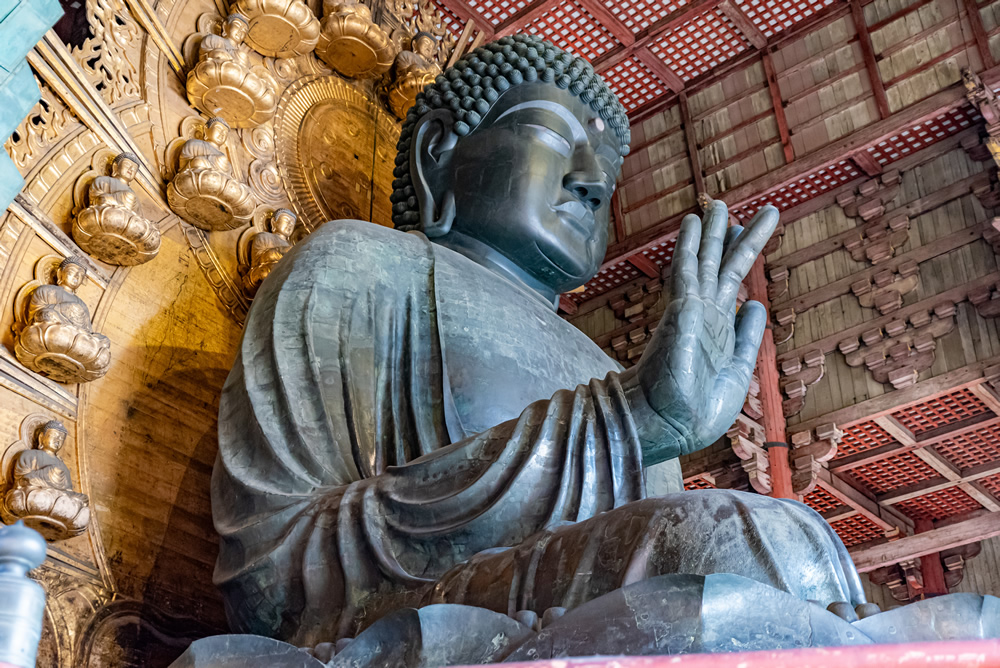
Todai-ji Temple is a representative temple of the Nara period and was constructed at the initiation of Emperor Shomu. The Vairocana Buddha (Great Buddha of Nara) enshrined in the Buddha Hall is a monumental gilt bronze Buddhist statue approximately 15 meters in height, one of the world’s largest, symbolizing the ideology of national peace and state governance through Buddhism.
The current Buddha Hall was rebuilt during the Edo period, but Nara-period architecture remains in the Shosoin, the Hokke-do (Sangatsudo), and the Tegai Gate. The Shosoin in particular is renowned as a “treasure house” housing approximately 9,000 precious objects associated with Emperor Shomu, conveying to the present day a cosmopolitan collection of objects transmitted through the Silk Road.
The architectural complex of Todai-ji Temple is important evidence demonstrating the scale and technical level of Nara-period temple architecture and has played a central role in the history of Japanese Buddhism.
2. Kohfuku-ji Temple
Kohfuku-ji Temple was founded as the ancestral temple of the Fujiwara clan in 710 with the relocation of the capital to Heijo-kyo. Its five-story pagoda stands approximately 50 meters tall, the second highest wooden pagoda in Japan after the five-story pagoda of To-ji Temple, and has become a symbol of Nara.
The temple houses numerous masterpieces of Nara-period Buddhist sculptural art, including the Asura statue and the Eight Legions of Heaven, as well as the Ten Great Disciples. The National Treasure Museum displays these Buddhist statues, allowing visitors to observe the evolution of Buddhist art from the Nara through the Kamakura periods.
Kohfuku-ji developed alongside the rise of the Fujiwara clan and held substantial power as the de facto ruler of Yamato Province (present-day Nara Prefecture) from the Heian through the Kamakura periods, playing an important role in Japanese political history.
3. Kasuga Taisha Shrine
Kasuga Taisha was founded in 768 and is a representative shrine of the Nara period. Enshrining the tutelary deity of the Fujiwara clan, it developed while maintaining close connections with Kohfuku-ji Temple. The main hall exemplifies the Kasuga architectural style of shrine architecture, with vermillion-painted buildings creating a beautiful landscape.
Approximately 3,000 stone lanterns and hanging lanterns have been donated to the shrine grounds. During the “Lantern Festival” held twice yearly, a phantasmagoric scene unfolds. These lanterns speak to the accumulation of faith continuing from the Heian period to the present day and are valuable cultural properties.
Kasuga Taisha is an important example demonstrating the history of Shintoism-Buddhism syncretism, with its integrated form of worship with Kohfuku-ji continuing until the Meiji Separation of Shinto and Buddhism. Today, style-renewal ceremonies are conducted every twenty years, with traditional architectural techniques and faith continuing to be transmitted.
4. Kasuga Primeval Forest
The Kasuga Primeval Forest is a forest of approximately 250 hectares in the sacred precinct of Kasuga Taisha where hunting and logging have been prohibited since 841. Protected without human interference for over 1,100 years, it maintains a nearly pristine natural environment despite its proximity to an urban area.
The vegetation, centered on evergreen broadleaf forest, is representative of Japan’s natural vegetation from the temperate to subtropical zones and holds academic value. It also plays an important role as a habitat for wild animals such as deer.
The Kasuga Primeval Forest is included as a constituent asset of the world heritage site as an exemplary case where a sacred forest has been protected over the long term, with cultural landscape and natural environment preserved as an integrated whole.
5. Ganjoji Temple
Ganjoji Temple is the relocation of Asuka-dera (Hokonji Temple), Japan’s earliest full-scale Buddhist temple, which moved with the relocation of the capital to Heijo-kyo. The tiles used in the Gokuraku-do and Zen’shitsu date from the Asuka period and are considered Japan’s oldest tiles, possessing extremely high cultural property value.
Once counted among the seven great temples of the southern capital, it declined after the medieval period, with the Gokuraku-do (main hall) and Zen’shitsu (monks’ quarters) remaining as its principal structures. These buildings have undergone Kamakura-period renovations but contain many materials from the Nara period, serving as valuable resources for understanding the evolution of ancient temple architecture.
Ganjoji is highly regarded as an important heritage demonstrating the continuity of Buddhist culture from the Asuka to the Nara period and as a temple conveying the dawn of Japanese Buddhism.
6. Yakushi-ji Temple
Yakushi-ji Temple was founded in 680 by Emperor Tenmu in prayer for the recovery of the empress (later Emperor Jito) from illness and was relocated to its present location following the relocation of the capital to Heijo-kyo. Its East Pagoda, which retains Nara-period architecture, is a three-story pagoda that appears to have six stories due to its eaves structure, earning the epithet “Frozen Music” for its graceful appearance.
The Golden Hall, West Pagoda, Central Gate, and galleries were reconstructed from the Showa to Heisei periods, faithfully recreating White Phoenix-style architecture, allowing visitors to experience the temple complex of that era. The Yakushi Triad (national treasure) is known as one of the finest examples of White Phoenix-period Buddhist sculptural art.
Yakushi-ji Temple is also notable as an example demonstrating modern approaches to ancient temple architecture restoration, showing methods of cultural property preservation and utilization.
7. Toshodai-ji Temple
Toshodai-ji Temple was founded in 759 by Ganjin Wajo, a high Buddhist priest who came from the Tang Dynasty. Ganjin finally arrived in Japan on his sixth voyage and is revered for transmitting formal Buddhist precepts to Japan.
The Golden Hall is one of the buildings that best retains Nara-period architectural style and is regarded as a masterpiece embodying the essence of Tenpyo architecture. The Lecture Hall was relocated from the East Pavilion of Heijo Palace, representing a valuable example of the conversion of palace architecture to temple use. The drum pavilion, scripture repository, treasure house, and other structures also retain Nara-period architecture.
Toshodai-ji is a temple symbolizing the history of cultural exchange between Japan and China and is an important heritage conveying to the present the indomitable spirit of Ganjin Wajo and international Buddhist exchange.
8. Heijo Palace Site
The Heijo Palace Site is located at the center of Heijo-kyo and was the site of palaces and government buildings. Within a range of approximately 1.3 kilometers east to west and approximately 1 kilometer north to south were arranged the Imperial Residence, the Daigokuden (Hall of State), the Asuka-in (Court of Cereals), where political affairs were conducted, and other structures.
The site is now maintained as a national park, with the First Daigokuden, Suzaku Gate, and East Court Garden reconstructed. Wooden tablets excavated through archaeological surveys serve as first-rate materials for understanding the Nara-period administrative system and social life, contributing significantly to ancient history research.
The Heijo Palace Site is the only archaeological site conveying to the present the appearance of Japan’s capital in the 8th century and is an important historic site demonstrating ancient capital city systems and the influence of East Asian urban planning. Standing in the vast space, one can sense the grandeur of the capital from 1,300 years ago.
Registration Criteria and Value as a World Heritage Site
The “Cultural Heritage of Ancient Nara” was recognized as meeting the following four of six evaluation criteria for UNESCO world heritage cultural properties.
Registration Criterion (ii): Evidence of Cultural Exchange
The cultural properties of Nara were formed as a result of cultural exchange in 8th-century East Asia. Through exchange with the Tang Dynasty of China and nations of the Korean Peninsula, architectural techniques, Buddhist philosophy, and artistic styles were transmitted to Japan, and these merged with Japan’s natural environment to produce a unique culture. Buildings and artworks that narrate this process of cultural exchange are well preserved.
Registration Criterion (iii): Evidence of Cultural Tradition
The “Cultural Heritage of Ancient Nara” is outstanding evidence of Japan’s ancient civilization and the cultural tradition of the Nara period. Elements forming the foundation of Japanese culture are comprehensively preserved, including the political system centered on Heijo-kyo, Buddhist-based philosophy, and Shintoism-Buddhism syncretistic religious faith.
Registration Criterion (iv): Outstanding Examples of Architectural Style
The wooden architecture of the Nara period, such as Todai-ji, Toshodai-ji, and Yakushi-ji temples, demonstrates the highest level of architectural technology in East Asia at that time. In particular, as wooden architecture from the same period no longer exists in China or the Korean Peninsula, these structures are extremely precious heritage from a world history perspective.
Registration Criterion (vi): Association with Universal Value
The cultural properties of Nara are closely related to the history of the transmission and development of Buddhism, a world religion. Additionally, they hold universal value as evidence demonstrating international exchange and cultural reception within the East Asian cultural sphere.
Unity of Constituent Assets and Buffer Zones
The characteristic of the “Cultural Heritage of Ancient Nara” is that the eight assets do not stand alone but together constitute one world heritage site. These assets are organically connected within Nara City’s historical landscape and comprehensively express the culture of ancient Nara.
In the registration as a world heritage site, buffer zones were established around the assets themselves. Buffer zones are areas for protecting the landscape and environment of world heritage sites, with restrictions on building height and landscape regulations applied. In Nara City, town development harmonized with world heritage sites is being advanced through plans for maintaining and improving historic districts.
Historical Significance Conveyed by Nara’s Cultural Properties
Formation of Japan’s Unique Buddhist Culture
The Nara period was an era when Buddhism developed under state protection and Japan’s unique Buddhist culture was formed. The establishment of provincial temples and nunneries by Emperor Shomu and the construction of the Great Buddha of Todai-ji reflected the ideology of state governance through Buddhism. Simultaneously, fusion with Shintoism (Shintoism-Buddhism syncretism) also advanced, giving birth to Japan’s distinctive religious culture.
Japan’s Position in the East Asian Cultural Sphere
During the Nara period, Japan actively absorbed continental culture through the dispatch of envoys to Tang. However, rather than mere imitation, Japan received these influences while transforming them into forms suited to its own terrain and society. The “Cultural Heritage of Ancient Nara” is valuable evidence demonstrating this process of cultural reception and independent development.
Inheritance of Wooden Architecture Technology
The survival of wooden architecture from the Nara period signifies the inheritance of repair and preservation techniques spanning over 1,200 years. Style-renewal ceremonies, regular repairs, and the inheritance of traditional architectural techniques have preserved these structures to the present day through Japan’s cultural property protection system.
Coexistence of Tourism and Preservation
The “Cultural Heritage of Ancient Nara” is also one of Japan’s leading tourist destinations, visited by millions of tourists annually. Achieving both economic benefits from tourism and cultural property protection is an important issue in world heritage management.
Nara City is implementing measures toward realizing sustainable tourism, including systems to allocate admission fees to cultural property repair and preservation, entrance restrictions during peak times, and information provision utilizing digital technology.
The coexistence of local residents’ lives and world heritage is also an important theme. Issues unique to Nara, such as coexistence with deer around Kasuga Taisha and maintaining historic landscapes while sustaining urban functions, are being addressed through cooperation among administration, residents, and specialists.
Passing on to the Future
To pass the “Cultural Heritage of Ancient Nara” to future generations, nurturing personnel who understand and transmit its value is essential beyond mere physical preservation. Nara City is placing emphasis on world heritage education, training cultural property volunteers, and fostering inheritors of traditional techniques.
Additionally, the construction of digital archives is underway to preserve detailed records of cultural properties for use in research and education. Through 3D scanning and virtual reality technology, cultural property information, including details that are physically difficult to access, can now be widely shared.
The world heritage site “Cultural Heritage of Ancient Nara” is both a precious heritage inherited from the past and a responsibility for us living in the present to pass on to the future. Visiting cultural properties bearing 1,300 years of history offers an opportunity to touch the wellspring of Japanese culture and reaffirm its value.
Summary
The “Cultural Heritage of Ancient Nara” is a world cultural heritage site comprising eight assets: Todai-ji Temple, Kohfuku-ji Temple, Kasuga Taisha, Kasuga Primeval Forest, Ganjoji Temple, Yakushi-ji Temple, Toshodai-ji Temple, and Heijo Palace Site. Since its registration in 1998, it has been highly evaluated domestically and internationally as a precious heritage conveying the history and culture of the Nara period to the present day.
When visiting Nara City in Nara Prefecture, understanding the true value of the world heritage site comes through not only viewing individual cultural properties but also sensing the historical landscape of “Ancient Nara” that these assets constitute collectively. For us living in the present to experience the essence of culture built by people 1,300 years ago and pass it on to the future—this is the significance of the world heritage site “Cultural Heritage of Ancient Nara.”
