The National Museum of Western Art’s World Heritage Registration Reasons and Complete Sightseeing Guide [Ueno, Tokyo]
The National Museum of Western Art, located in Ueno Park in Taito Ward, Tokyo, was registered as a UNESCO World Cultural Heritage site on July 17, 2016. Its main building was designed by Le Corbusier, one of the three great masters of modern architecture in the 20th century, and was registered collectively with 17 works across 7 countries as a constituent property of “The Architectural Work of Le Corbusier, an Outstanding Contribution to the Modern Movement.”
This article provides a detailed explanation of why the National Museum of Western Art was registered as a World Heritage site, the architectural characteristics reflecting Le Corbusier’s design philosophy, major holdings, and practical information for visitors.
Overview and History of the National Museum of Western Art
Background and Purpose of Its Establishment
The National Museum of Western Art, Japan’s only national museum specializing in Western art, opened in April 1959 (Showa 34). Its establishment was rooted in postwar cultural exchange between France and Japan.
Before the war, there was an enormous collection of artworks known as the “Matsukata Collection,” gathered by businessman Matsukata Kojiro across Europe. These works remained in France during wartime but were seized by the French government after the war. In 1959, as part of cultural exchange between Japan and France, portions of these works were returned to Japan, and the National Museum of Western Art was established to house and display them.
Operation by the National Museum of Art, Independent Administrative Institution
Today, the National Museum of Western Art is operated by the National Museum of Art, an independent administrative institution. The National Museum of Art, together with the Tokyo National Museum of Modern Art, the Kyoto National Museum of Modern Art, the National Film Archive of Japan, the National Museum of Art, Osaka, and the National Art Center, Tokyo, plays an important role in advancing Japan’s art and culture.
The National Museum of Western Art houses approximately 6,000 works, primarily consisting of Western paintings from the late Middle Ages through the early 20th century and French modern sculpture centered on Rodin. The permanent exhibition is designed to allow visitors to systematically understand the flow of Western art through these collections.
Details of World Heritage Registration
Registration Name and Constituent Property
The National Museum of Western Art’s main building was registered on July 17, 2016, at the 40th Session of the World Heritage Committee held in Istanbul, Turkey, under the name “The Architectural Work of Le Corbusier, an Outstanding Contribution to the Modern Movement.”
This was registered as a “Transnational Serial Nomination” comprising 17 constituent properties spanning 7 countries: France, Switzerland, Belgium, Germany, Argentina, India, and Japan. Only the National Museum of Western Art’s main building was included as a constituent property from Japan, making it Tokyo’s first World Heritage site and Japan’s 20th overall.
Reasons for World Heritage Registration
The primary reason the National Museum of Western Art was registered as a World Heritage site is that it embodies the architectural philosophy of Le Corbusier, who profoundly influenced the modern architectural movement of the 20th century.
Le Corbusier (born Charles-Édouard Jeanneret, 1887-1965) was a Swiss-born French architect known as one of the three great masters of modern architecture. He proposed the “Five Points of Architecture,” exerting revolutionary influence on 20th-century architecture.
The National Museum of Western Art’s main building is a work designed by Le Corbusier in his later years, where his architectural theories reached their culmination. In particular, it is highly regarded worldwide as the only architectural realization of the unique concept of “Musée à croissance illimitée” (Museum of Unlimited Growth).
The World Heritage Committee recognized Le Corbusier’s 17 works as demonstrating “outstanding contribution to the modern architectural movement of the 20th century,” acknowledging their universal value. As the museum is the only such work in Asia, it serves as an important constituent property proving the global reach of modern architectural thought.
Path to Registration
The World Heritage registration of the National Museum of Western Art resulted from international cooperation over many years.
In 2007, the French government added “The Architectural Work of Le Corbusier” to the World Heritage tentative list. Initially featuring only works within France, the approach was changed to joint nomination by multiple countries considering Le Corbusier’s international influence.
In 2009, the Japanese government added the National Museum of Western Art’s main building to the World Heritage tentative list. Subsequently, seven countries cooperated to prepare the nomination documents, which were formally submitted to the World Heritage Committee in 2015.
In May 2016, ICOMOS (International Council of Monuments and Sites) recommended “inscription,” and formal registration was decided by the World Heritage Committee in July of the same year. This registration made Taito Ward, Tokyo, a municipality possessing a World Heritage site, with its cultural value internationally recognized.
Le Corbusier’s Architectural Philosophy and the National Museum of Western Art
Who Was Le Corbusier?
Le Corbusier (1887-1965) was a 20th-century architect, urban planner, and designer. His birth name was Charles-Édouard Jeanneret-Gris, born in La Chaux-de-Fonds, Switzerland.
He is sometimes called the father of modern architecture and is counted among “the three great masters of modern architecture” alongside Frank Lloyd Wright and Ludwig Mies van der Rohe. Le Corbusier was far more than an architect; he also worked as an architectural theorist, urban planner, painter, and sculptor, exerting incalculable influence on 20th-century architecture and urban planning.
The Five Points of Architecture
The “Five Points of Architecture” (Les cinq points de l’architecture moderne), proposed by Le Corbusier in 1926, is an innovative architectural theory maximizing the potential of reinforced concrete construction.
- Pilotis: Raising the building on columns to keep the ground floor open
- Roof Terrace: Using a flat roof as a garden
- Free Plan: Separating the structural frame from partition walls to enable free spatial design
- Ribbon Windows: Long horizontal windows ensuring light and views
- Free Facade: Architectural freedom independent from the structure
The National Museum of Western Art’s main building incorporates these principles throughout, making it a valuable architectural work where visitors can directly experience Le Corbusier’s design philosophy.
The Unlimited Growth Museum Concept
The greatest feature of the National Museum of Western Art’s main building is the realization of the “Musée à croissance illimitée” (Museum of Unlimited Growth), a unique concept by Le Corbusier.
This concept represents a pioneering design philosophy in which even as an art museum’s collection increases, the building can expand organically. Exhibition rooms are arranged in a spiral pattern extending outward from the center, allowing additional display space to be added outward as needed.
Le Corbusier nurtured this idea from the 1930s onward, proposing it in several projects, but the National Museum of Western Art’s main building is the only one actually constructed. This point particularly elevates its value as a World Heritage site.
At the building’s center is a large open space called the 19th Century Hall, from which exhibition rooms spiral outward. Visitors are naturally guided from the center outward and upward, with the spatial design for art appreciation becoming one with the architecture itself.
Collaboration with Japanese Architects
The design of the National Museum of Western Art’s main building involved three Japanese architects who studied under Le Corbusier.
- Sakakura Junzo (1901-1969): Studied at Le Corbusier’s atelier and designed the Japanese pavilion at the 1937 Paris Exposition
- Maekawa Kunio (1905-1986): Trained under Le Corbusier and designed the Tokyo Bunka Kaikan (Tokyo Metropolitan Theatre)
- Yoshisaka Takamasa (1917-1980): Studied under Le Corbusier and designed the University Seminary House
While Le Corbusier handled the basic design, since construction took place in Japan, these three architects managed detailed design and site supervision. Their cooperation resulted in architecture that faithfully reproduced Le Corbusier’s philosophy while adapting to Japan’s climate and culture.
This collaboration serves as an excellent example of international dissemination of modern architectural thought and its unique development in respective regions, further enhancing the museum’s value as a World Heritage site.
Architectural Features of the National Museum of Western Art’s Main Building
Exterior and Structure
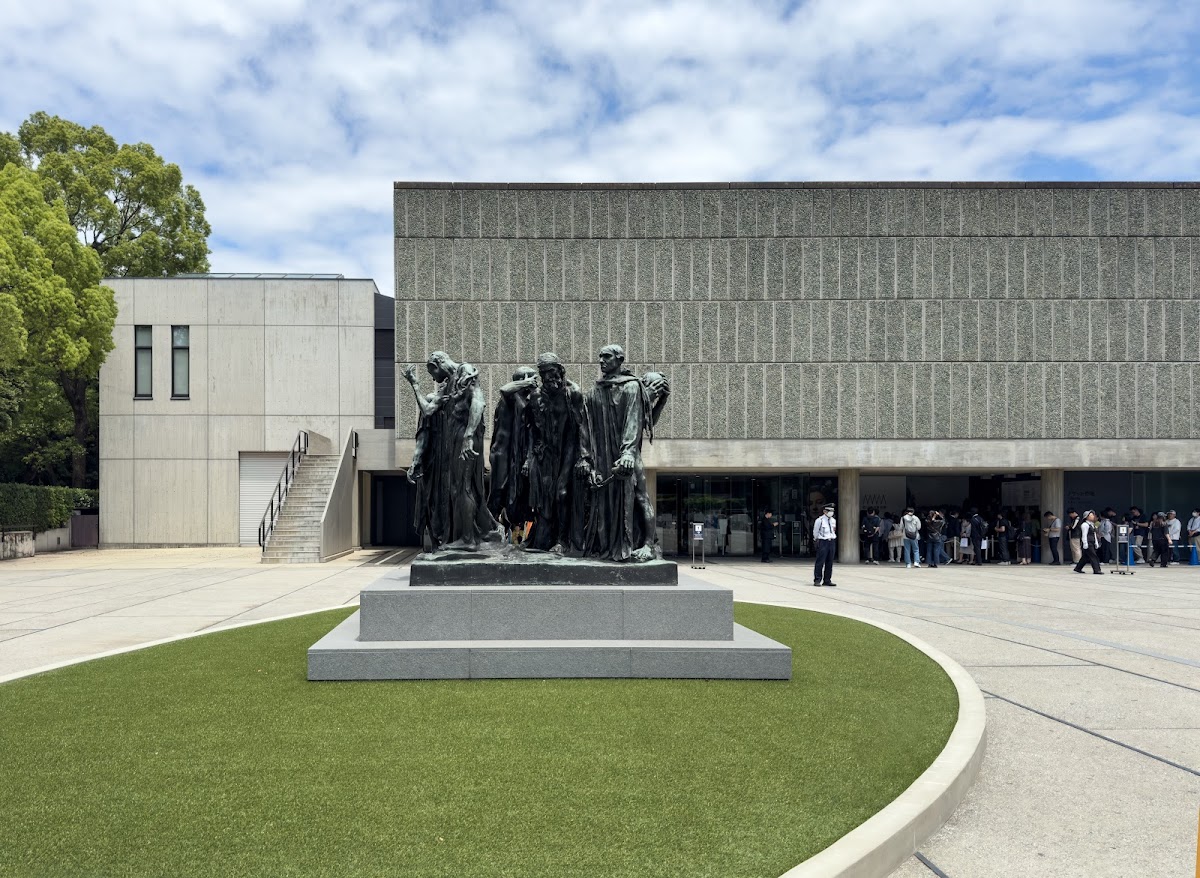
The National Museum of Western Art’s main building, completed in 1959, is a reinforced concrete structure. Its exterior is characterized by a distinctive design where cubic boxes appear to float on thick columns (pilotis).
The building consists of three above-ground floors and one basement level, with a total floor area of approximately 4,400 square meters. The exterior walls feature exposed concrete, directly expressing the material quality Le Corbusier preferred.
A spacious plaza precedes the main entrance, where Rodin sculptures including “The Gates of Hell,” “The Thinker,” and “The Burghers of Calais” are displayed, welcoming visitors. The landscape formed by these sculptures and building together constitutes the cultural center of Ueno Park.
The building’s placement considers the topography of Ueno Park and surrounding environment, with careful design to maximize natural light. Particularly, triangular skylights in the 19th Century Hall’s ceiling allow natural light to gently spread throughout the exhibition spaces.
Interior Space Characteristics
The National Museum of Western Art’s interior is arranged in a spiral pattern emanating from the central 19th Century Hall, embodying the “Museum of Unlimited Growth” concept.
The 19th Century Hall is a vast open space displaying Rodin’s sculptures. Natural light descending through the triangular skylights creates shadows on the sculptures, allowing visitors to enjoy changing light expressions throughout the day.
Exhibition rooms are arranged spiraling clockwise from the central hall, enabling visitors to experience works through a natural traffic flow. Ceiling heights and wall arrangements in each exhibition room are finely adjusted to suit the characteristics of displayed works.
The second floor applies “Modulor,” Le Corbusier’s unique dimensional system based on human body measurements, realizing harmonious space.
Expansion and Preservation Restoration
Since opening, the National Museum of Western Art’s main building underwent several expansions as collections grew.
In 1979, a new building designed by Maekawa Kunio was added, including special exhibition galleries, restaurants, and a museum shop. This new building harmonizes with the main building while incorporating Maekawa’s own architectural expression.
Only the Le Corbusier-designed main building portion and grounds (plaza) are registered as World Heritage sites, but the entire museum, including the new building, functions as an integrated whole.
From October 2020 to April 2022, the main building closed for major preservation and restoration work. This project involved seismic reinforcement, equipment updates, and restoration to recover the building’s original appearance after over 60 years of operation.
Particularly, portions altered through aging and past modifications were restored based on Le Corbusier’s original design. Work included restoration of exposed concrete wall finishes, lighting equipment updates, and air-conditioning system improvements, preserving architectural value while enhancing the museum’s modern functions.
This preservation and restoration project, drawing international attention as an important initiative to transmit World Heritage value to the future, was undertaken with meticulous care.
Major Holdings and Collections
History of the Matsukata Collection
The core of the National Museum of Western Art’s collection is the “Matsukata Collection.”
Matsukata Kojiro (1866-1950) was an industrialist active as president of Kawasaki Shipbuilding (now Kawasaki Heavy Industries). Using funds gained during World War I’s favorable business conditions, he collected large quantities of art in Europe from around 1916 to 1927.
Matsukata’s aim was to establish a comprehensive Western art museum in Japan, providing young Japanese artists opportunities to encounter authentic Western art. He purchased approximately 3,000 works—paintings, sculptures, and prints—centered in London and Paris.
However, the 1927 financial panic caused a management crisis at Kawasaki Shipbuilding, halting Matsukata’s collection plans. Many works stored in London were destroyed in a 1939 fire, and those remaining in Paris were seized by the French government during World War II.
After the war, as part of Japan-France cultural exchange, approximately 400 works were returned from the French government in 1959, and the National Museum of Western Art was established to house and display them. Matsukata’s dream was finally realized after his death.
Representative Painting Works
The National Museum of Western Art systematically houses Western paintings from the 14th century through the early 20th century, with particularly rich collections of 19th-century French painting.
Impressionist and Post-Impressionist works include Claude Monet’s “Water Lilies,” Pierre-Auguste Renoir’s “Parisian Women in Algerian Dress,” and Édouard Manet’s “Portrait of Monsieur Blanc.”
Barbizon School works include Jean-François Millet’s “Spring” and Camille Corot’s “Souvenir of Mortefontaine.”
Renaissance through 18th-century works include Peter Paul Rubens’s “Abundance,” Tintoretto’s “The Baptism of Christ,” and “Annunciation” by the Jan van Eyck School.
20th-century art includes works by Pablo Picasso, Georges Braque, and Paul Klee, forming a collection enabling understanding of modern art’s progression.
Sculpture Collection Centered on Rodin
The National Museum of Western Art’s sculpture collection centers on works by Auguste Rodin (1840-1917) and is known as Japan’s most comprehensive Rodin collection.
Matsukata Kojiro held Rodin’s art in deep regard and collected numerous works. The museum currently houses over 60 Rodin pieces.
“The Gates of Hell” is Rodin’s masterwork, inspired by Dante’s “Inferno,” displayed in the front plaza where it greets visitors.
“The Thinker,” originally created as part of “The Gates of Hell,” is Rodin’s world-famous masterpiece. The large bronze sculpture displayed in the plaza is a popular visitor photography spot.
“The Burghers of Calais” is a group sculpture based on historical events during the Hundred Years’ War, expressing human dignity and sacrificial spirit.
Beyond these outdoor displays, the 19th Century Hall features important works including “Balzac” and “The Bronze Age,” allowing comprehensive understanding of Rodin’s art.
Prints and Drawings Collection
The National Museum of Western Art houses approximately 5,000 prints and drawings.
This collection encompasses Western print history from the 15th through 20th centuries, including works by masters such as Albrecht Dürer, Rembrandt van Rijn, and Francisco Goya.
Prints and drawings, being light-sensitive, are not permanently displayed but are publicly shown through thematic special exhibitions several times yearly. These works serve as valuable research materials for Western art history studies.
Designated Cultural Properties
Some works in the National Museum of Western Art’s holdings are designated as Japanese cultural properties.
Rodin’s “The Gates of Hell,” “The Thinker,” and “The Burghers of Calais” are designated as Important Cultural Properties, pioneering cultural property designation for Western art works in Japan.
The collection group forming the core of the Matsukata Collection is academically highly valued as important cultural heritage demonstrating Japan’s cultural modernization and Western culture acceptance.
Practical Information and Access
Opening Hours and Closed Days
Regular Opening Hours
- Permanent exhibition: 9:30 AM–5:30 PM (until 8:00 PM on Fridays and Saturdays)
- Special exhibitions: Varies by exhibition
- Admission until 30 minutes before closing
Closed Days
- Every Monday (If Monday is a national holiday or compensatory holiday, the museum is open and closed the following weekday)
- Year-end and New Year holidays (December 28–January 1)
- Other temporary closures
※Opening hours and closed days may change. It is recommended to check the official website for the latest information before visiting.
Admission Fees
Permanent Exhibition
- General: 500 yen
- University students: 250 yen
- High school students and those under 18: Free
- Age 65 and over: Free (with proof)
Special Exhibitions
- Varies by exhibition
- Special exhibition admission ticket covers permanent exhibition access
Free Admission Days
- 2nd and 4th Saturdays of each month: Permanent exhibition free
- November 3 (Culture Day): All exhibitions free
- International Museum Day (May 18): Permanent exhibition free
How to Access
By Train
The National Museum of Western Art, located in Ueno Park, is accessible by walk from multiple stations.
- JR Ueno Station: 1-minute walk from the Park Exit
- Tokyo Metro Ginza Line and Hibiya Line Ueno Station: 8-minute walk from Exit 7
- Keisei Electric Railway Keisei-Ueno Station: 7-minute walk from the main exit
Exiting JR Ueno Station’s Park Exit and proceeding straight through Ueno Park, the National Museum of Western Art’s building appears immediately. From Tokyo Station, it takes approximately 10 minutes by JR Yamanote Line or Keihin-Tohoku Line; from Narita Airport, approximately 40 minutes by Keisei Skyliner, providing excellent accessibility.
By Car
The National Museum of Western Art has no dedicated parking. Visitors arriving by car must use paid parking lots surrounding Ueno Park. However, parking is limited around Ueno Park and becomes congested on weekends or during special exhibitions, making public transportation recommended.
Barrier-Free Accessibility
The National Museum of Western Art accommodates wheelchair visitors. The entrance features a ramp, and elevators access exhibition rooms on each floor. Wheelchair rental is available (advance reservation recommended).
Nearby Cultural Facilities
Ueno Park, also called the “Forest of Culture,” concentrates many cultural facilities around the National Museum of Western Art.
- Tokyo National Museum: Japan’s oldest museum and repository of Japanese art
- National Museum of Nature and Science: Comprehensive natural history and science museum
- Tokyo Metropolitan Museum of Art: Prefectural art museum hosting competitive and special exhibitions
- Ueno Royal Museum: Private art museum operated by the Japan Art Association
- Tokyo Bunka Kaikan (Tokyo Metropolitan Theatre): Classical music concert hall
- Ueno Zoo: Japan’s oldest zoo
Visiting the National Museum of Western Art along with these facilities allows enjoying culture and art throughout the day.
Educational Activities at the National Museum of Western Art
Lectures and Gallery Talks
The National Museum of Western Art implements various educational programs deepening understanding of artworks.
Architecture Tours allow viewing the World Heritage-registered main building’s architectural features with expert staff explanations. Visitors learn about Le Corbusier’s design philosophy, the Museum of Unlimited Growth concept, and preservation work details.
Permanent Exhibition Gallery Talks feature curators explaining works on display. Hearing about works’ appeal, art historical context, and acquisition history enriches understanding through guided appreciation.
Special Exhibition-Related Lectures feature experts including art historians, architects, and researchers explaining exhibition themes in accessible language.
School Education Collaboration
The National Museum of Western Art actively collaborates with school education.
School Programs provide appreciation programs tailored to educational levels from elementary through university. By advance reservation, curators provide explanations and facilitate worksheet-based active appreciation.
Teacher Programs offer training helping educators wanting to incorporate the museum into classes, covering appreciation education methods and museum utilization knowledge.
Digital Archives and Online Content
The National Museum of Western Art actively advances information dissemination using digital technology.
The official website publishes a searchable database of holdings with high-resolution images allowing work examination. Searchable by title, artist, and creation date, these serve education and art history research.
Virtual exhibition rooms enable 360-degree panoramic image gallery viewing from home.
The museum regularly posts on social media (Twitter, Instagram, Facebook), sharing exhibition information, work introductions, and architectural appeal to broad audiences.
Preservation and Utilization as a World Heritage Site
Preservation Management Plan
The World Heritage-registered National Museum of Western Art’s main building must maintain its universal value for future generations through appropriate preservation.
The Agency for Cultural Affairs, Tokyo, Taito Ward, and the National Museum of Art, Independent Administrative Institution, collaborate to formulate the “National Museum of Western Art Main Building Preservation and Utilization Plan.” This plan prioritizes balancing the building’s physical preservation, appropriate restoration, and museum utilization.
Regular building surveys, deterioration monitoring, and preventive preservation measures ensure World Heritage value is not compromised.
International Cooperation
As “The Architectural Work of Le Corbusier” comprises international World Heritage from 7 countries and 17 properties, related institutions across nations cooperate on preservation and utilization.
Periodic international conferences facilitate preservation technique sharing, research exchange, and joint promotion. As Asia’s only constituent property, the National Museum of Western Art is expected to model sustainable preservation and utilization of modern architectural heritage transcending regions.
Community Collaboration and Tourism Promotion
World Heritage registration significantly impacts cultural tourism promotion in the Ueno area.
Taito Ward pursues World Heritage-leveraging tourism strategies including multilingual pamphlet creation, signage improvements, and guided tour implementation.
Promoting Ueno Park overall as a “Forest of Culture” successfully attracts domestic and international tourists. Particularly for foreign visitors, visiting Japan’s only Le Corbusier architecture comprises an important Tokyo tourism goal.
Sustainable Utilization
Balancing World Heritage preservation with operation as an active museum presents significant challenges.
The National Museum of Western Art continues efforts improving modern museum functions (barrier-free access, security, air-conditioning) while protecting architectural value.
The 2020-2022 major preservation restoration project enhanced seismic performance, updated equipment, and improved display environments, all implementing Le Corbusier’s original design, maintaining the building’s essential value.
This approach represents an internationally recognized example of “adaptive reuse” of historic architecture in contemporary contexts.
Conclusion: The National Museum of Western Art’s Appeal and Visiting Significance
The National Museum of Western Art is not merely a museum but a significant modern architecture history landmark and an achievement of Japanese cultural diplomacy.
As the sole “Museum of Unlimited Growth” embodying Le Corbusier’s architectural philosophy, its World Heritage-registered main building is itself an artwork. Visitors experience architectural innovation through spatial experience while appreciating Western art masterpieces.
Beginning from Matsukata Kojiro’s vision, this museum was born as a postwar Japan-France cultural exchange symbol and has become a representative Japanese museum attracting approximately one million annual visitors.
Its location in Ueno Park, concentrating cultural facilities, and accessibility—approximately 10 minutes by train from Tokyo Station—are additional attractions. Reasonable permanent exhibition admission fees make it a museum inviting repeat visits.
Visiting the World Heritage National Museum of Western Art offers three significant experiences: art appreciation, architectural experience, and learning 20th-century cultural history—a rich cultural encounter. When visiting Tokyo, please visit this World Heritage site and experience Le Corbusier’s architectural space and Western art masterpieces.