Himeji Castle, Hyogo Prefecture, World Heritage Site – Comprehensive Explanation of the History, Highlights, and Cultural Properties of Shirasagi Castle
What is Himeji Castle – Japan’s Premier Castle Registered as a World Heritage Site
Himeji Castle, located in Himeji City, Hyogo Prefecture, was registered as a UNESCO World Cultural Heritage site in December 1993 alongside the Horyu-ji Temple in Nara, making it one of Japan’s first world heritage sites and a representative example of Japanese castle architecture. With its elegant white walls, it is affectionately known by the alternative name “Shirasagi Castle” (White Heron Castle), and attracts approximately 1.5 million visitors annually from both Japan and abroad, making it a leading cultural heritage site representing Hyogo Prefecture.
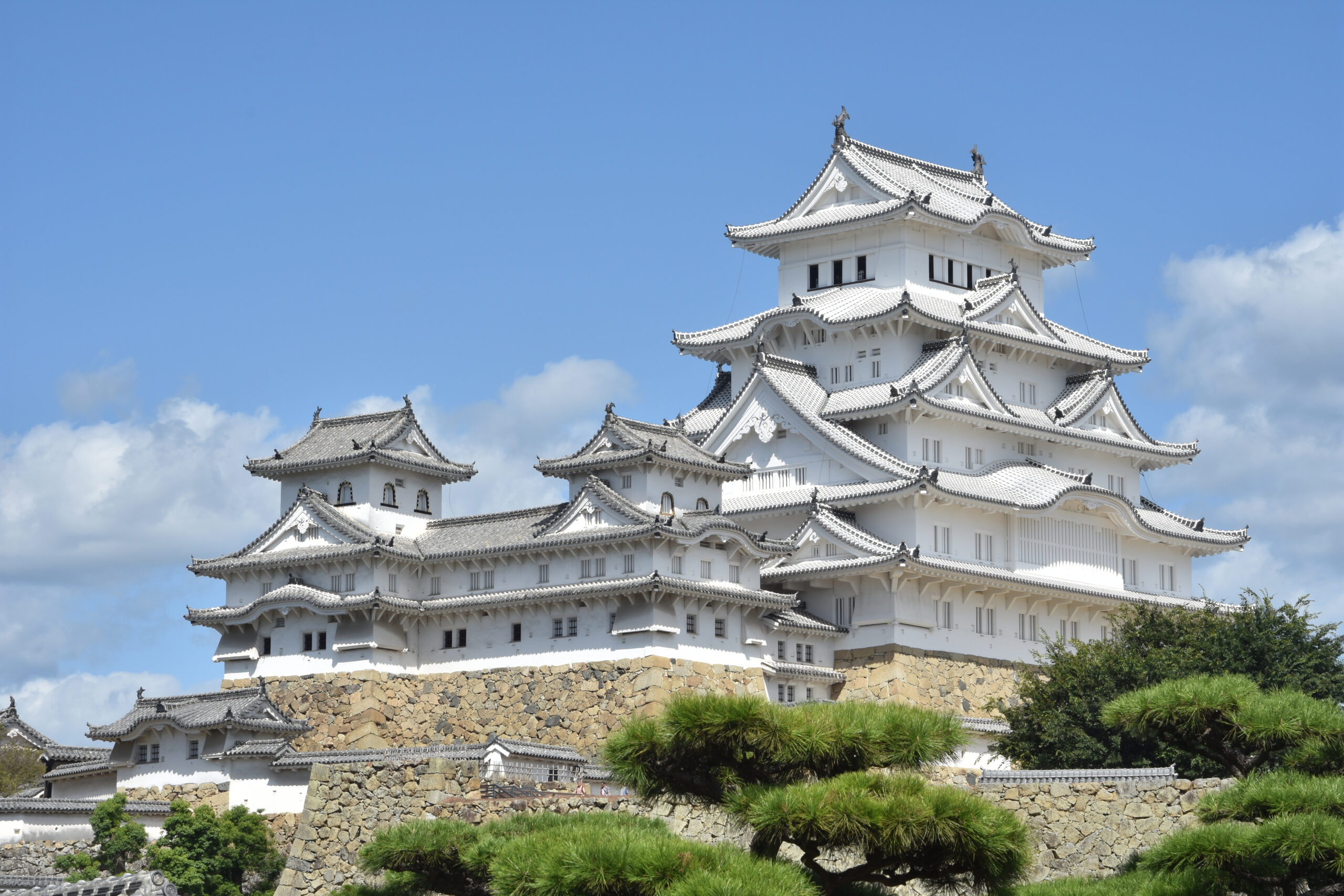
The white-plaster-coated tenshu (main towers) that stand out against the blue sky possess the beauty of a white heron soaring from a water’s surface. The main architectural structures built in the early Edo period, including the tenshu and turrets, remain extant, with 8 structures designated as National Treasures and 74 as Important Cultural Properties.
Evaluation Criteria for World Heritage Registration
Himeji Castle’s registration as a World Heritage site was based on high evaluation of the following points, as it is representative of castle architecture from the early 17th century in Japan:
- Excellence in Architectural Technology: A masterpiece of wooden architecture, unparalleled in its structural beauty globally
- Good Preservation Condition: Approximately 400 years since its construction, it has escaped damage from warfare and natural disasters, maintaining its original appearance
- Harmony of Defensive Function and Aesthetic Beauty: A remarkable fusion of military fortress functionality and elegant exterior
- Cultural Value: A structure group that perfectly embodies the unique Japanese castle style
Unlike many world heritage castles elsewhere, which are predominantly stone or brick, Himeji Castle is notable in that its principal structures, aside from moats and stone walls, are primarily wooden.
The Origin of the Name and Alternative Name “Shirasagi Castle”
The name Himeji Castle derives from the geographic location name Himeji City, Hyogo Prefecture. The toponym “Himeji” itself has been used to refer to this region since ancient times.
The Origin of Shirasagi Castle
The most famous alternative name for Himeji Castle is “Shirasagi Castle” (White Heron Castle). Various theories exist regarding this name, but the main reasons are:
- White-Plaster Exterior: The entire castle’s beautiful white walls, created by white plaster coating, resemble the appearance of a white heron spreading its wings
- Legend of Himeyama: A white heron legend associated with Himeyama, the hill on which the castle stands
- Elegant Appearance: The continuous arrangement of the tenshu towers evokes the graceful flight of a white heron
The name Shirasagi Castle extends beyond being merely a metaphor of appearance, symbolizing the elegance and dignity of Himeji Castle, and is widely cherished by local residents and tourists alike.
History and Development of Himeji Castle
The Beginning of Castle Construction (14th Century)
The history of Himeji Castle is said to have begun when Akamatsusadanori built a fortification on Himeyama in 1346 (Shohei 1st year) during the Northern and Southern Dynasties period. Though a small residential structure at the time, it occupied an important position as a strategic point in Harima Province.
Development During the Warring States Period
In 1580 (Tensho 8th year), Toyotomi Hideyoshi (then known as Hashiba Hideyoshi) after pacifying Harima Province, took Himeji Castle as his own residence. Hideyoshi conducted major renovations to transform it into a modern castle with a three-story tenshu, and Himeji Castle began to take proper shape as a full-fledged castle complex.
Major Reconstruction by Ikeda Terumasa (Early Edo Period)
The basic structure of the present Himeji Castle was built by Ikeda Terumasa, who distinguished himself at the Battle of Sekigahara, between 1601 (Keicho 6th year) and 1609 (Keicho 14th year), over eight years with enormous expenditure.
Ikeda Terumasa, a daimyo with a 520,000 koku stipend, entered Himeji and significantly expanded and reconstructed the previous castle. He arranged a five-story six-floor main tenshu and three smaller tenshu in a continuous formation, completing a modern castle complex of the highest standard of the time, with its intricate layout and solid stone walls.
Changes in Castle Lords During the Edo Period
Throughout the Edo period, Himeji Castle was valued as a strategic point in western Japan, and was governed by fudai daimyo and shimpan (related daimyo):
- Ikeda Clan (1600-1617): Major reconstruction by Terumasa
- Honda Clan (1617-1639): Construction of the Western Bailey by Tadamasa
- Sakakibara Clan, Matsudaira Clan and others: Subsequently governed by prominent daimyo
- Sakai Clan (1749-1868): Remained as castle lords until the end of the Bakumatsu period
Preservation After the Meiji Restoration
After the Meiji Restoration, while many castles were demolished under the abolition of the castle system, Himeji Castle’s main structures were preserved as it was used as an Imperial Army garrison. In 1931 (Showa 6th year), it was designated as a National Treasure under the National Treasure Preservation Law, marking the beginning of its protection as a cultural property.
The Miracle of Escaping War Damage
On July 3, 1945 (Showa 20th year) during World War II, Himeji City suffered massive air raids, but Himeji Castle miraculously escaped destruction. Though incendiary bombs fell on the tenshu, they failed to detonate, and while the surrounding castle town became a burned wasteland, the white tenshu remained unscathed.
The Structure and Architectural Characteristics of Himeji Castle
The Structure of the Continuous Tenshu
The greatest characteristic of Himeji Castle is its “continuous tenshu” formation, with a main tenshu at the center connected via passageways to three smaller tenshu (East, West, and Northwest), creating one of the most complex and elegant forms in Japanese castle architecture.
Structure of the Main Tenshu:
- Exterior: 5 stories, Interior: 1 basement level, 6 floors above ground
- Height: Approximately 31.5 meters (from the stone wall)
- Width: Approximately 21 meters east to west, 17 meters north to south
- Skillful structural technique as a wooden building
Ingenuity in Defense Functions
Himeji Castle possesses sophisticated defensive functions as a military stronghold, not merely aesthetic beauty:
Maze-like Layout:
- Complex intersecting passages and gates
- Gates arranged in alphabetical order from “I-no-Mon” to “Ni-no-Mon” to “Ho-no-Mon”
- Design to confuse enemies and make attacks difficult
Stone Wall Technology:
- Solid castle walls using advanced stone-stacking techniques
- Graceful slopes called “sensu no koubai” (fan gradient) that are beautiful yet difficult to scale
- Three concentric moats surrounding the complex
Slit Windows and Stone Drops:
- Approximately 1,000 slit windows for shooting arrows and firearms
- Mechanisms to drop stones on enemies climbing the stone walls
- Hidden rooms and escape passages as defense installations
The Beauty of White-Plaster Overall Coating
The white walls of Himeji Castle represent white-plaster overall coating that serves both fire prevention and aesthetic purposes. Not only the walls but also tile joints and woodwork are coated with white plaster, creating the pure white beauty that is the origin of the name “Shirasagi Castle.”
White plaster possesses fire-resistance properties, serving an important role in protecting the wooden structure from fire, a fundamental weakness of wooden buildings. Through periodic replastering, it has maintained its beauty for 400 years.
History of Repairs and the Heisei Major Restoration
Showa Major Restoration (1956-1964)
After the war, as Himeji Castle’s main tenshu deteriorated, a “Showa Major Restoration” was conducted over eight years beginning in 1956 (Showa 31st year). This restoration included:
- Disassembly and restoration of the tenshu
- Correction of tilted pillars
- Replacement of rotted structural members
- Seismic reinforcement work
- Total cost of 550 million yen (at that time)
This major restoration restored Himeji Castle’s structural stability and opened the path to World Heritage registration.
Heisei Major Restoration (2009-2015)
From 2009 (Heisei 21st year) to 2015 (Heisei 27th year), a “Heisei Major Restoration” was conducted. The main construction work included:
Roof Tile Replacement:
- Complete replacement of approximately 75,000 tiles
- Replastering of white walls
- Weight reduction of tiles for improved seismic resistance
Replastering of White Walls:
- Complete replacement of exterior plaster
- Application using traditional techniques
- Pure white brilliance that became a topic of conversation as “too white”
Seismic Reinforcement:
- Reinforcement based on the latest seismic diagnostics
- Construction methods that do not damage traditional appearance
After completion, Himeji Castle regained its original brilliance and once again attracted attention as the “excessively white castle.” As time passes, the plaster has settled, and it now maintains an elegant whiteness.
The Process of World Heritage Registration and Its Significance
The Path to Registration
Himeji Castle’s World Heritage registration was realized through the following process:
1992: Japanese government submits recommendation to UNESCO
September 1993: Field survey by ICOMOS (International Council of Monuments and Sites)
December 11, 1993: Official registration decision at the 17th UNESCO World Heritage Committee (Cartagena, Colombia)
It was registered as Japan’s first World Cultural Heritage site along with the Buddhist Structures of the Horyu-ji Temple area.
Registration Criteria
Himeji Castle meets the following UNESCO World Heritage registration criteria:
Criterion (i): Outstanding representation of human creative talent
- The pinnacle of wooden architecture technology
- Perfect harmony of defensive function and aesthetic elements
Criterion (iv): Outstanding example of architectural style from an important historical period
- The supreme masterpiece of castle architecture from the early 17th century in Japan
- Complete embodiment of the unique Japanese castle style
Management and Preservation as a World Heritage Site
Following World Heritage registration, Himeji City has implemented the following efforts:
- Formulation of Conservation Management Plans: Balancing cultural property protection and tourism
- Regular Repair and Inspection: Thorough preventive conservation
- Conservation of Surrounding Environment: Protection of castle town scenery through landscape ordinances
- Visitor Management: Limiting daily castle entry numbers during congestion
- Educational Activities: Efforts to communicate the value of the World Heritage site
In 2023, marking the 30th anniversary of World Heritage registration, commemorative projects were implemented.
Status of National Treasure and Important Cultural Property Designations
National Treasure Designated Structures (8 buildings)
The following structures at Himeji Castle have been designated as National Treasures:
- Main Tenshu
- East Small Tenshu
- West Small Tenshu
- Northwest Small Tenshu
- Passageway I
- Passageway Ro
- Passageway Ha
- Passageway Ni
These form the core of the continuous tenshu arrangement and are evaluated as the highest peak of Japanese castle architecture.
Important Cultural Property Designated Structures (74 buildings)
In addition to the National Treasures, 74 structures including turrets, gates, and earthen walls have been designated as Important Cultural Properties:
Major Turrets:
- Kesho Turret (Western Bailey)
- Hishi Gate
- Ni-no-Mon Gate
- Ho-no-Mon Gate
- Water First and Second Gates
Earthen Walls and Stone Walls:
- Earthen walls surrounding each bailey
- Complex stone wall groups
Special Historic Site Designation
The entire Himeji Castle ruins have been designated as a National Special Historic Site, protecting the entire castle complex ruins as cultural property. The designated area covers approximately 107 hectares.
Highlights and Facilities Within the Castle
Tenshu Group
Interior of Main Tenshu:
- Displays of armor and historical materials on each floor
- Steep staircases (maximum gradient of 55 degrees)
- Views of Himeji cityscape from the top floor
- Panoramic views in four directions: east, west, south, and north
Small Tenshu:
- Unique structure connected by passageways
- Design emphasizing defensive function
- Complex internal structure
Western Bailey
Built by Honda Tadamasa, the Western Bailey served as the residence of Senhime (daughter of Tokugawa Hidetada):
- Kesho Turret: Building associated with Senhime
- Hyakuken Hallway: Approximately 300-meter-long corridor
- Western Bailey Garden: Elegant Japanese garden
Stone Walls and Moats
Three Concentric Moats:
- Inner, middle, and outer moats providing triple defense
- Total circumference of approximately 2,700 meters
Stone Wall Technology:
- Various construction techniques from different periods: rough surface stacking, jointed fitting, and dressed stone fitting
- Beautiful curves called “fan gradient”
- Stone walls reaching maximum heights of 26 meters
Trees and Nature Within the Castle
The Himeji Castle grounds contain approximately 1,000 trees, presenting beautiful scenery throughout the four seasons:
Cherry Blossom Viewing Spot:
- Approximately 1,000 cherry trees centered on Somei Yoshino varieties
- Selected as one of Japan’s 100 Cherry Blossom Viewing Sites
- Spectacular views of the tenshu and cherry blossoms from Sannomaru Plaza
Other Trees:
- Giant camphor and zelkova trees
- Foliage trees with beautiful autumn colors
- Greenery supporting the ecosystem within the castle
Facilities Surrounding Himeji Castle
Koko-en Garden:
- Japanese garden developed on the former western mansion site of Himeji Castle
- Pond-stroll-style garden consisting of nine garden sections
- Tea house “Soju-an” where one can enjoy tea
- Also famous as a location for historical drama filming
Hyogo Prefectural History Museum:
- Exhibition of the history of Himeji Castle and its castle town
- Museum of castle architecture research
- Experience corners for children
Former Karō Residence Site Park:
- Preservation of samurai residence ruins
- Experience the atmosphere of an Edo period castle town
Legends and Culture Related to Himeji Castle
The Story of Senhime
The most famous legend associated with Himeji Castle is the story of Senhime (1597-1666). Born as the daughter of Tokugawa Hidetada, Senhime married Toyotomi Hideyori at age 7, but when he committed suicide during the Summer Campaign of Osaka, she later remarried Honda Tadatoki and spent ten years in the Western Bailey of Himeji Castle.
The Kesho Turret and Hyakuken Hallway where Senhime lived remain important sightseeing attractions today, and the story of Senhime as a tragic heroine adds elegance to the history of Himeji Castle.
The Legend of the Okiku Well
A well known as the setting for “Banshu Sarashiki” (a traditional Japanese tale) still exists within the castle. The legend of the loyal maid Okiku being falsely accused and thrown into a well has become the subject of kabuki and rakugo storytelling, becoming widely known as a Japanese ghost story.
The actual well is preserved as “Okiku’s Well” in the Kamiyamari lower area and has become a popular tourist destination.
Connection with Miyamoto Musashi
A legend remains that the swordmaster Miyamoto Musashi eliminated demons in Himeji Castle’s vicinity. It is said that he defeated a demon inhabiting the Himeji Castle tenshu, and the relationship between Musashi and Himeji Castle continues to be passed down locally.
Access to Himeji Castle and Tourism Information
Transportation Access
By Train:
- Approximately 20-minute walk from JR Himeji Station or Sanyo Electric Railway Himeji Station
- Excellent location with views of the castle from the station
- Beautiful tree-lined avenue from the north exit of Himeji Station to the castle
By Bus:
- Shinki Bus from Himeji Station to “Himeji Castle Otemon Mae” stop, immediate arrival
- Tourist loop buses also operate
By Car:
- Approximately 15 minutes from “Himeji East IC” on the Sanyo Expressway
- Paid parking available nearby (Himeji Castle Otemon Parking Lot, etc.)
Operating Hours and Admission Fees
Operating Hours:
- 9:00 AM to 5:00 PM (last admission 4:00 PM)
- Summer season (April 27 to August 31): 9:00 AM to 6:00 PM (last admission 5:00 PM)
Closed Days:
- December 29-30
Admission Fees:
- Adults (18 years and older): 1,000 yen
- Elementary, Middle, and High School Students: 300 yen
- Combined ticket with Koko-en Garden: 1,050 yen for adults
Tourism Tips
Time Required:
- Main tenshu only: approximately 1 hour
- Entire castle grounds: 2-3 hours
- Including Koko-en Garden: 3-4 hours
Peak Seasons:
- Cherry blossom season (late March to early April)
- Golden Week holidays
- Autumn foliage season (November)
- Entry restrictions apply during congestion
Recommended Times:
- Early morning after opening (9:00-10:00 AM)
- Weekday afternoons (2:00-4:00 PM)
Photography Spots:
- Full tenshu view from Sannomaru Plaza
- Continuous tenshu view from Western Bailey
- Tenshu view from Koko-en Garden
- Night illumination (seasonal)
Himeji Castle and Japanese Castle Culture
Positioning in Japan’s 100 Famous Castles
Himeji Castle is ranked 59th in Japan’s “100 Famous Castles” and boasts the largest scale among the 12 existing tenshu. It is also included in the following selections:
- The Five National Treasure Castles (Himeji Castle, Matsumoto Castle, Inuyama Castle, Hikone Castle, Matsue Castle)
- The Three Famous Castles (Himeji Castle, Nagoya Castle, Kumamoto Castle)
- Japan’s 100 Cherry Blossom Viewing Sites
Value as Castle Architecture
Himeji Castle is extremely important in understanding the development of Japanese castle architecture:
Technological Innovation:
- The unique continuous tenshu structure
- Advanced wooden architecture techniques
- Perfect fusion of beauty and function
Historical Value:
- Complete preservation of construction techniques from the early Edo period
- Architecture representing the transition from the Warring States period to the Edo period
- Completion as a castle during a peaceful era
Cultural Influence:
- A structure symbolizing Japanese aesthetic sensibilities
- Role in conveying Japanese culture internationally
- Film and drama location site as a medium for cultural expression
Conservation of Himeji Castle and Succession to Future Generations
Conservation Efforts
Himeji City and the Agency for Cultural Affairs implement the following activities to pass Himeji Castle on to future generations:
Regular Inspection and Repair:
- Detailed surveys every five years
- Preventive conservation for extended service life
- Recording and succession of traditional techniques
Succession of Craftsman Techniques:
- Training of shrine carpenters and plasterers
- Recording and transmission of traditional techniques
- Technique succession through restoration work
Research and Investigation:
- Scientific analysis of architectural techniques
- Collection and research of historical materials
- Latest technology seismic diagnostics
Balancing Tourism and Preservation
With approximately 1.5 million visitors annually, Himeji Castle faces the challenge of balancing tourism promotion with cultural property protection:
Visitor Management:
- Entry restrictions during congestion
- Consideration of reservation systems
- Route design for visitor distribution
Surrounding Area Development:
- Scenic conservation of the castle town
- Revitalization of historic streetscapes
- Enhancement of tourism facilities
The 30th Anniversary of World Heritage Registration and the Future
Having marked the 30th anniversary of World Heritage registration in 2023, Himeji Castle is advancing the following initiatives for the next 30 years and beyond:
- Updating conservation management plans
- Information dissemination using digital technology
- Promotion of international cultural exchange
- Educational activities for future generations
- Realization of sustainable tourism
How to Enjoy a Visit to Himeji Castle
Himeji Castle in Each Season
Spring (March to May):
- Competition between cherry blossoms and the tenshu (late March to early April)
- Beauty of fresh greenery
- Events such as cherry blossom viewing parties
Summer (June to August):
- White walls reflected against blue sky
- Contrast with abundant green foliage
- Extended operating hours for summer
Autumn (September to November):
- Harmony between autumn foliage and white walls
- Photography in clear air
- Events such as moon-viewing parties
Winter (December to February):
- Snow-covered tenshu (rare)
- Austere beauty under winter clear skies
- Relatively uncrowded period
Nearby Tourist Attractions
Within Himeji City:
- Shoshazan Engyoji Temple: Described as the Western Tendai school
- Himeji Central Park: Safari park and amusement park
- Himeji City Art Museum: Building with beautiful red bricks
Nearby Areas:
- Ako Castle Ruins: Castle associated with the 47 Ronin story
- Akashi Castle: Continued Japanese 100 Famous Castles
- Takeda Castle Ruins: Popular as the “castle in the sky”
Food Information
Himeji Oden:
- Unique style eaten with ginger soy sauce
- Available at izakayas in the castle town
Conger Eel Cuisine:
- Dishes using conger eel from the Harima Sea
- Available at specialist restaurants near Himeji Station
Cafes Near Himeji Castle:
- Tea room within Koko-en Garden
- Restaurants where one can dine while viewing the castle
Conclusion
Himeji Castle, located in Himeji City, Hyogo Prefecture, was registered in 1993 as Japan’s first World Cultural Heritage site and represents the finest of Japanese castle architecture. The elegant white-walled tenshu towers, affectionately known by its alternative name, Shirasagi Castle, are a masterpiece gathering the quintessence of construction techniques from the early 17th century and comprises an invaluable cultural heritage with 8 National Treasure structures and 74 Important Cultural Properties.
For approximately 400 years since its major reconstruction by Ikeda Terumasa, Himeji Castle has maintained its original appearance, escaping warfare and natural disasters, and has received high international acclaim for its excellence as a wooden structure, the perfect harmony of defensive function and aesthetic elements, and its excellent preservation condition.
Following Showa and Heisei major restorations, Himeji Castle continues to present a beautiful appearance today, welcoming approximately 1.5 million visitors annually and continuing to convey Japan’s history and culture both domestically and internationally. Marking the 30th anniversary of World Heritage registration, efforts toward succession to the next generation are underway, and it will continue as a cultural heritage of which Japan is proud, transmitting its value to future generations.
When visiting Himeji Castle, beyond merely appreciating the beauty of the tenshu, one can gain a deeper appreciation of Himeji Castle’s charm by exploring the complex layout, advanced stone wall technology, the nature within the castle grounds, and legends of figures such as Senhime and Okiku. The white heron castle, displaying different faces in each of the four seasons, is a cultural heritage of which Japan is proud to the world, with new discoveries awaiting with each visit.