
Mozu and Furuichi Kofun Groups: Complete Guide to Osaka’s World Heritage Site | Thorough Explanation of History, Constituent Assets, and Highlights
What is the Mozu and Furuichi Kofun Group?
The Mozu and Furuichi Kofun Group (百舌鳥・古市古墳群) is a cemetery complex from the Kofun period spanning three cities in Osaka Prefecture: Sakai, Habikino, and Fujiidera. On July 6, 2019, at the 43rd UNESCO World Heritage Committee held in Baku, Azerbaijan, it was officially registered as a World Cultural Heritage site under the name “Mozu-Furuichi Kofun Group: Mounded Tombs of Ancient Japan.” This marked a historic moment as Osaka Prefecture’s first World Heritage designation.
This kofun group consists of 45 properties comprising 49 kofun built between the late 4th century and late 5th century, the peak period of the Kofun era. Located on a plain adjacent to Osaka Bay, which was one of the political and cultural centers of the time and a key departure point for routes to the continent, this precious cultural heritage conveys the power structure and society of ancient Japan to the present day.
Outstanding Universal Value as a World Heritage Site
The Mozu and Furuichi Kofun Group was recognized as a World Heritage site due to its outstanding universal value. The kofun group is composed of kofun showing diversity in size and shape, from massive keyhole-shaped mounds approaching 500 meters in length to small-scale burial mounds of just over 20 meters, and is valued as a unique burial complex in the world.
These kofun are important evidence testifying to the hierarchical social structure of ancient Japan, advanced civil engineering techniques, and the burial practices and spiritual culture of the time. In particular, the keyhole-shaped mound (zenpo-koen fun), a burial form unique to the Japanese archipelago, symbolizes the cultural uniqueness of ancient Japan.
Historical Background of the Mozu and Furuichi Kofun Group
Political and Cultural Center of the Kofun Era
From the late 4th to late 5th century, the peak of the Kofun era, the Osaka Plain was one of the centers of ancient Japanese politics and culture. This region functioned as a gateway for contact with the continent, serving as an important junction for the influx of advanced technology and culture from the Korean Peninsula and mainland China.
The period when the Mozu and Furuichi Kofun Group was built coincides with the era when the Yamato polity was expanding its influence across a wide range of the Japanese archipelago. The construction of massive kofun required enormous labor and sophisticated organizational capacity, and these kofun functioned as monuments demonstrating the tremendous power of the rulers of that time.
Construction Technology and Social Organization
The construction of the Mozu and Furuichi Kofun Group employed the most advanced civil engineering techniques of the era. In constructing the mounds, soil from surrounding areas was transported in large quantities and layered up using the hanshiki (rammed earth) method. In the case of the largest Nintoku Emperor Mausoleum Kofun (Daisenyo Kofun), it is estimated that over 6.8 million person-days of labor were required.
The surface of the kofun was covered with stones called fukiishi, and at various points on the mound, cylindrical haniwa and figural haniwa were positioned. These haniwa were not mere decoration but served important roles in marking sacred areas and in burial rituals.
Constituent Assets and Characteristics of the Mozu Kofun Group
Overview of the Mozu Area
The Mozu Kofun Group, located in Sakai City, Osaka Prefecture, has 23 kofun as World Heritage constituent assets. Distributed over an area of approximately 4 kilometers east-west and north-south, more than 100 kofun once existed, but many have been lost due to urbanization.
The kofun group in the Mozu area was planned and laid out on a plateau, suggesting an ancient urban planning perspective. Currently, kofun remain scattered throughout residential and commercial areas, forming a unique landscape where the ancient and modern coexist.
Nintoku Emperor Mausoleum Kofun (Daisenyo Kofun)
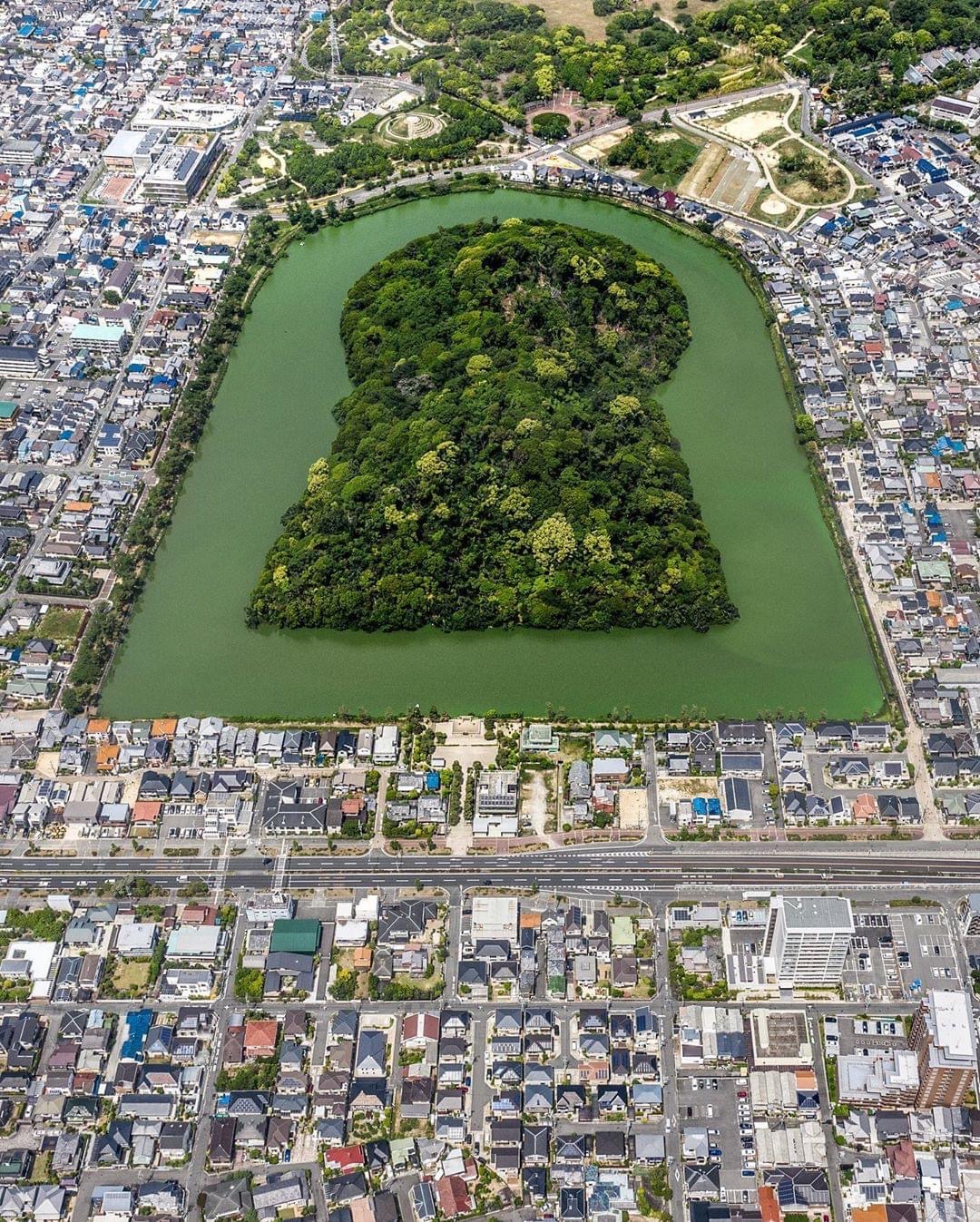
The central figure of the Mozu Kofun Group is the Nintoku Emperor Mausoleum Kofun (Daisenyo Kofun), which boasts a mound length of approximately 486 meters. This is the largest keyhole-shaped mound in Japan and is counted as one of the world’s three greatest tombs alongside Egypt’s Great Pyramid of Khufu and China’s Mausoleum of the First Qin Emperor.
The mound, surrounded by three layers of moats, forms a beautiful keyhole shape when viewed from above, and its grand scale tells of the absolute power of ancient Japan’s rulers. The total mound area reaches approximately 460,000 square meters, and the entire area including the surrounding moat amounts to approximately 1 million square meters.
Richutsu Emperor Mausoleum Kofun (Misanzai Kofun)
The Richutsu Emperor Mausoleum Kofun, with a mound length of approximately 365 meters, is Japan’s third-largest keyhole-shaped mound. Located in the northern part of the Mozu Kofun Group, it is a grand kofun with three layers of moats like the Nintoku Emperor Mausoleum Kofun.
Stone coffin fragments and haniwa were once excavated from this kofun, and its construction is estimated to date from the early 5th century. Based on the mound’s shape and scale, the buried individual was undoubtedly a member of the highest ruling class of that time.
Other Major Kofun
In the Mozu area, there exist keyhole-shaped mounds of diverse scales, including Nisanzai Kofun (mound length approximately 290 meters), Byodozan Kofun (mound length approximately 203 meters), and Itasuke Kofun (mound length approximately 146 meters).
Itasuke Kofun is known as a kofun preserved through citizen activism against a development plan in the 1950s and has become a symbol of Sakai City. The statue of a badger on the mound is beloved as a symbol of the preservation movement.
Constituent Assets and Characteristics of the Furuichi Kofun Group
Overview of the Furuichi Area
The Furuichi Kofun Group, spanning Habikino City and Fujiidera City in Osaka Prefecture, has 26 kofun as World Heritage constituent assets. Distributed over an area of approximately 2.5 kilometers east-west and 4 kilometers north-south, these kofun were built during the peak of the Kofun era, much like the Mozu Kofun Group.
The Furuichi area is located on a plateau facing the ancient Lake Kawachi, serving as a key point for water transport. This geographic condition is thought to have greatly influenced the formation of the giant kofun group.
Ojin Emperor Mausoleum Kofun (Honden Goryosan Kofun)
The largest kofun in the Furuichi Kofun Group is the Ojin Emperor Mausoleum Kofun (Honden Goryosan Kofun), with a mound length of approximately 425 meters. This is Japan’s second-largest keyhole-shaped mound and is estimated to have been built in the early 5th century.
This kofun, with its two-layered moats, has a mound volume reaching approximately 1.43 million cubic meters, requiring enormous labor and materials for its construction. The buried individual is said to be the Ojin Emperor, but there are various theories about the actual occupant.
Nakatsu Princess Mausoleum Kofun (Nakatsu Mountain Kofun)
The Nakatsu Princess Mausoleum Kofun, with a mound length of approximately 290 meters, is identified as the mausoleum of Nakatsu Princess, said to have been the consort of the Ojin Emperor. Located in the central part of the Furuichi Kofun Group, it exhibits an elegant keyhole shape.
This kofun has two-layered moats, and its mound was covered with fukiishi and haniwa. Estimated to have been constructed in the mid-5th century, it is one of the best-preserved kofun in the Furuichi Kofun Group.
Other Kofun in the Furuichi Area
The Furuichi Kofun Group includes kofun of diverse scales such as Hatayama Kofun (mound length approximately 225 meters) and Ingyotennno Emperor Mausoleum Kofun (mound length approximately 230 meters). Additionally, numerous small round mounds and rectangular mounds exist, reflecting the hierarchical structure of society.
Minegatsuka Kofun is one of the few kofun where visitors can climb to the summit, from which one can appreciate the expanse of the Furuichi Kofun Group.
Path to World Heritage Registration
Developments Leading to World Heritage Recommendation
Efforts toward World Heritage registration of the Mozu and Furuichi Kofun Group began in earnest in 2010. Osaka Prefecture, Sakai City, Habikino City, and Fujiidera City established the “Mozu and Furuichi Kofun Group World Cultural Heritage Registration Promotion Headquarters Conference” and proceeded with preparations for registration.
In July 2017, the Agency for Cultural Affairs selected the Mozu and Furuichi Kofun Group as a recommendation candidate for 2019 World Heritage registration. Following this, in January 2018, a formal recommendation document was submitted to the UNESCO World Heritage Centre.
ICOMOS Investigation and Evaluation
In September 2018, experts from the International Council on Monuments and Sites (ICOMOS) conducted an on-site survey. The investigation examined in detail the conservation state of the kofun, authenticity, integrity, and protective management systems.
On May 14, 2019, ICOMOS recommended that the Mozu and Furuichi Kofun Group be “inscribed” on the World Heritage List. This recommendation represented the highest evaluation on a four-tier scale, making World Heritage registration virtually certain. ICOMOS evaluated that the kofun group constituted prominent evidence of ancient Japanese social structure and burial culture.
Inscription Decision at the World Heritage Committee
On July 6, 2019, at the 43rd World Heritage Committee held in Baku, Azerbaijan, the formal decision was made to inscribe the Mozu and Furuichi Kofun Group on the World Cultural Heritage List. This became the first World Heritage registration in the Reiwa era and Osaka Prefecture’s first such designation.
The inscription name was designated as “Mozu-Furuichi Kofun Group: Mounded Tombs of Ancient Japan,” with 45 properties comprising 49 kofun registered as constituent assets.
Details of Constituent Assets
Selection Criteria for Constituent Assets
The 45 properties comprising 49 kofun registered as World Heritage were selected based on the following criteria. First, they must be kofun constructed between the late 4th and late 5th centuries. Second, they must be representative of the characteristics of the Mozu and Furuichi Kofun Group. Third, they must be in good condition and allow understanding of the essential values of the kofun.
The constituent assets include not only large keyhole-shaped mounds but also medium and small-scale keyhole-shaped mounds, round mounds, and rectangular mounds, demonstrating the diversity and hierarchy of burial mounds in the Kofun era.
Diversity in Kofun Shape and Scale
The constituent assets of the Mozu and Furuichi Kofun Group range from the Nintoku Emperor Mausoleum Kofun at 486 meters in length to small-scale kofun of just over 20 meters, showing extreme diversity. This diversity is thought to reflect differences in the social status and power of the buried individuals.
The keyhole-shaped mound is a burial form unique to the Japanese archipelago, with more than 30 keyhole-shaped mounds included in the Mozu and Furuichi Kofun Group. Round mounds and rectangular mounds, though smaller than keyhole-shaped mounds, each have their own characteristics and demonstrate the richness of Kofun-era burial culture.
Arrangement of Mounds and Haniwa
The mounds were not simple earth accumulations but were constructed based on precise designs. Fukiishi was laid on the mound’s surface to prevent erosion of the slopes and to enhance the kofun’s grandeur.
Cylindrical haniwa were arranged in rows at various points on the mound, marking sacred spaces. Figural haniwa (depicting people, animals, vessels, and other objects) were also positioned to express burial rituals and the buried individual’s life before death. These haniwa are invaluable materials for understanding the society and culture of the Kofun era.
Highlights of the Mozu and Furuichi Kofun Group
Sakai City Museum and Understanding the Kofun
When visiting the Mozu and Furuichi Kofun Group, it is recommended to first visit the Sakai City Museum. The museum displays detailed information on Kofun-era history, kofun construction methods, and excavated artifacts, deepening understanding of the kofun group.
In the VR theater, visitors can experience the construction process and appearance of the Nintoku Emperor Mausoleum Kofun through video, allowing them to feel the Kofun-era world firsthand. The museum also displays actual haniwa, pottery, and ornaments excavated from the kofun.
Model Courses for Visiting Kofun
In the Mozu area, a popular course starting from JR Hanwa Line “Mozu Station” allows visitors to tour major kofun on foot. The Nintoku Emperor Mausoleum Kofun worship site, Richutsu Emperor Mausoleum Kofun, Itasuke Kofun, Byodozan Kofun, and others can be visited in approximately three hours.
In the Furuichi area, courses starting from around Kintetsu Minami-Osaka Line “Haji no Sato Station” pass the Ojin Emperor Mausoleum Kofun and Nakatsu Princess Mausoleum Kofun. Rental bicycles make it more efficient to tour the kofun group.
Kofun View Spots
It is difficult to comprehend the full scope of massive kofun from ground level, but several view spots exist. From the observation lobby on the 21st floor of Sakai City Hall, one can see the entire Nintoku Emperor Mausoleum Kofun and truly appreciate its immense size.
Itasuke Kofun’s perimeter can be walked in a complete circuit, making it ideal for understanding the kofun’s three-dimensional structure. In the Furuichi area, Minegatsuka Kofun’s summit is open to visitors, allowing appreciation of the expanse of the kofun group.
Landscaping and Preservation Activities
Landscaping Projects Around the Kofun
Toward World Heritage registration, Osaka Prefecture and relevant municipalities undertook landscaping projects around the kofun. These included relocation of structures damaging the kofun’s landscape, beautification of surrounding roads, and installation of informational signs, improving the historical environment of the kofun.
Particularly around the Nintoku Emperor Mausoleum Kofun, the worship site approach was improved and the surrounding moat was dredged, efforts made to restore the kofun’s original appearance. Conservation of the greenery surrounding the kofun also progressed, enhancing its value as precious green space within the urban area.
Citizen-Participated Preservation Activities
The preservation of the Mozu and Furuichi Kofun Group is impossible without the cooperation of local residents. Citizen-participatory preservation activities include cleanup of kofun areas, training of volunteer guides, and hosting of public awareness events.
Sakai City established the “Mozu Kofun Group for World Heritage” citizens’ group, which promotes activities to communicate the value of the kofun. Additionally, kofun learning has been incorporated into school education to ensure transmission to future generations.
Heritage Utilization and Tourism
Utilization as a Tourism Resource
Following World Heritage registration, the Mozu and Furuichi Kofun Group has become an important tourism resource for Osaka Prefecture. Numerous domestic and international tourists visit to experience ancient Japanese history and culture.
Related municipalities have enhanced reception capacities through visitor center improvements, multilingual signage installation, and development of tourism apps. Tour buses visiting the kofun and guided walking tours have also been implemented.
Heritage Commercialization and Branding
Various products have been developed featuring the Mozu and Furuichi Kofun Group. Kofun-shaped sweets, keychains, T-shirts, and other merchandise are popular souvenirs.
As a regional brand, unique products such as “Kofun Curry” and “Kofun Wine” have appeared, contributing to increased awareness of the kofun. This commercialization has also stimulated the local economy.
Experience Using Digital Technology
Kofun experiences utilizing the latest digital technology are also offered. Using AR (augmented reality) applications, visitors can view the kofun’s original state or haniwa placement by holding a smartphone toward the site.
Facilities providing pseudo-experiences of kofun interiors and construction processes through VR (virtual reality) technology have also been established. These technologies are effective means of communicating the appeal of the kofun particularly to younger generations.
Access and Surrounding Information
Access to the Mozu Area
The nearest stations to the Mozu area are JR Hanwa Line “Mozu Station,” Nankai Koya Line “Sakaikita Station,” and “Mikuriya Station.” The area is accessible by train in approximately 30 minutes from central Osaka.
The Nintoku Emperor Mausoleum Kofun is approximately a 10-minute walk from JR “Mozu Station,” and the Sakai City Museum is approximately a 5-minute walk from Nankai “Mozu Hachiman Station.” As parking is limited, use of public transportation is recommended.
Access to the Furuichi Area
Access to the Furuichi area is via Kintetsu Minami-Osaka Line stations such as “Haji no Sato Station,” “Furuichi Station,” and “Fujiidera Station,” approximately 20-30 minutes from Osaka Abenobashi Station.
The Ojin Emperor Mausoleum Kofun is approximately a 5-minute walk from “Haji no Sato Station,” and rental bicycles from the station area are convenient for efficiently touring the Furuichi-area kofun group.
Surrounding Tourist Facilities
Various other historical and cultural facilities surround the Mozu and Furuichi Kofun Group. In Sakai, visitors can learn about the city’s history and culture at facilities including the Sen-no-Rikyu Residence Ruins, the Sakai Traditional Craft Museum, and Sakai Richo no Mori.
In Habikino and Fujiidera cities, historical structures from after the Kofun era, including Honда Hachiman Shrine, Kuzui-ji Temple, and Domyoji Tenmangu Shrine, are scattered throughout, and visiting these sites together provides deeper historical understanding.
Future Challenges and Prospects
Balancing Preservation and Development
Since the Mozu and Furuichi Kofun Group is located in an urban area, balancing preservation with urban development remains a constant challenge. Architectural regulations and landscape preservation in the World Heritage buffer zone require understanding and cooperation from residents.
Related municipalities are advancing sustainable preservation management plans, prioritizing kofun preservation while also considering improvements in residents’ living environments.
Progress in Academic Research
Many of the Mozu and Furuichi Kofun Group are managed by the Imperial Household Agency, making full-scale excavation surveys difficult. However, new insights may be obtained through surveys of surrounding areas and development of non-destructive survey techniques.
Investigations using the latest technologies such as radar exploration and three-dimensional surveying are proceeding, with expectations for deepened understanding of kofun structure and construction processes.
International Information Dissemination
As a World Heritage site, conveying the value of the Mozu and Furuichi Kofun Group internationally is also an important task. Efforts to increase global awareness of kofun culture are underway through multilingual information provision, active public relations to international media, and hosting of international academic conferences.
Additionally, exchange with World Heritage sites in other countries and comparative research of burial cultures worldwide from the same period as the Kofun era are important for clarifying the kofun’s value.
Conclusion
The Mozu and Furuichi Kofun Group is a cemetery of ancient Japanese rulers built during the peak of the Kofun era and was registered as Osaka Prefecture’s first World Cultural Heritage site in 2019. The 45 properties comprising 49 kofun built between the late 4th and late 5th centuries are diverse, ranging from massive mounds approaching 500 meters in length to small-scale burial mounds, testifying to the hierarchical social structure of the time and advanced civil engineering techniques.
The Mozu Kofun Group (Sakai City) and Furuichi Kofun Group (Habikino and Fujiidera cities), while each possessing distinct characteristics, together formed the center of ancient Japan’s politics and culture. Giant keyhole-shaped mounds including the Nintoku Emperor Mausoleum Kofun and Ojin Emperor Mausoleum Kofun possess unparalleled scale and form in the world, serving as precious cultural heritage demonstrating the uniqueness of ancient Japan.
Following World Heritage registration, these kofun groups have attracted international attention and increased importance as tourism resources. However, many challenges remain, including balancing preservation and utilization of the urban-located kofun group, promoting academic research, and ensuring transmission to future generations.
Visiting the Mozu and Furuichi Kofun Group offers a precious opportunity to touch ancient Japanese history and culture. Through museum study at the Sakai City Museum, walking tours of the kofun, and experiences utilizing digital technology, visitors can contemplate the Kofun era of 1,600 years ago and feel the endeavors and spiritual culture of ancient peoples. Transmitting this World Heritage site to the future is an important responsibility of we who live in the present.
