Hidden Christians of Nagasaki and Kumamoto Regions | Complete Guide to Nagasaki’s World Heritage Site
In July 2018, the “Hidden Christians of Nagasaki and Kumamoto Regions” was registered as Japan’s 22nd UNESCO World Cultural Heritage Site. This heritage site bears witness to the history of Hidden Christians (Kakure Kirishitan) who secretly preserved their faith during approximately 250 years from the 17th to 19th centuries, when Christianity was forbidden—a rare and invaluable cultural heritage with few parallels in the world.
This article provides a detailed explanation of the 12 component assets spanning Nagasaki and Kumamoto prefectures, covering their historical background, characteristics of each asset, and visiting methods.
What Are the Hidden Christians Heritage Sites?
Significance of World Heritage Registration
The Hidden Christians heritage sites of Nagasaki and Kumamoto are a group of assets that demonstrate an extremely rare cultural tradition in human history: the development of a unique form of faith during the period of Christian prohibition. This heritage was recognized as a World Heritage Site because believers, in the absence of missionaries, maintained their faith alone while coexisting with Japanese traditional religions and general society, sustaining their communities without isolation.
On June 30, 2018, at the 42nd World Heritage Committee session held in Bahrain, the outstanding universal value of this heritage was recognized, and its formal inscription on the UNESCO World Cultural Heritage List was decided.
Historical Background of Hidden Christians
In the mid-16th century, Christianity was introduced to Japan by Francis Xavier. In the Kyushu region centered on Nagasaki, many daimyo and common people converted to Christianity, and at one point it is said that there were tens of thousands of believers.
However, beginning with Toyotomi Hideyoshi’s 1587 decree expelling Christian missionaries (Bateren追放令), the Edo shogunate issued a nationwide prohibition on Christianity in 1614. Persecution of Christians gradually intensified. The Shimabara-Amakusa Rebellion (Shimabara no Ran), which occurred from 1637 to 1638, became a symbolic event of this persecution.
After suppressing the rebellion, the shogunate implemented thorough Christian persecution. Missionaries were expelled from the country, and believers were forced to abandon their public faith. However, believers in the Nagasaki and Amakusa regions chose to continue their faith in secret rather than abandoning it completely. This marked the beginning of “Hidden Christians.”
Uniqueness of Hidden Christians
The greatest characteristic of Hidden Christians was their coexistence with existing Buddhism and Shinto on the surface while maintaining unique Christian faith internally. They developed the following distinctive forms of belief.
Concealment of Faith: While disguising themselves as Buddhists or Shintoists, they secretly offered Christian prayers. They devised ingenious methods of concealing their faith, such as viewing Buddhist Kannon statues as images of the Virgin Mary (“Maria Kannon”) and creating hidden crosses that appeared to be Buddhist implements.
Oral Transmission of Teaching: Unable to obtain Bibles or theological texts, prayers and teachings were transmitted to the next generation orally. Latin prayers, whose meaning was not understood, were transmitted as sounds, becoming a unique form of prayer called “Oratio” (お拉祷/オラショ).
Creation of Sacred Sites: Instead of building churches, they found sacred places in nature. They revered mountains and islands as holy places where they secretly offered prayers.
Relocation to Maintain Faith: To escape persecution and continue their faith freely, they relocated to remote islands and peninsulas far from human settlement. In these places, they formed small communities and supported each other while maintaining their faith.
Detailed Explanation of the 12 Component Assets
The Hidden Christians heritage sites of Nagasaki and Amakusa comprise 12 component assets across 6 cities and 2 towns in Nagasaki and Kumamoto prefectures. Each conveys the story of Hidden Christians’ faith continuation from different perspectives.
1. Hara Castle Ruins (Minami-Takaki City)
The Hara Castle Ruins are the site of the final battle of the Shimabara-Amakusa Rebellion that occurred from 1637 to 1638. This rebellion was a peasant uprising against harsh tax collection and Christian persecution, but was thoroughly suppressed by the shogunate army.
Approximately 37,000 rebellion participants lost their lives at this location, after which the shogunate further strengthened its anti-Christian policy. This event became the catalyst for Christians to “hide” their faith, positioning the Hara Castle Ruins as the starting point of Hidden Christian history.
Today, the castle ruins preserve stonework and moats, testifying to the fierce battles of that time. Excavations have uncovered numerous Christian-related artifacts such as crosses, medals, and rosaries, which can be viewed at the on-site museum.
2. Sacred Sites and Villages of Hirado (Hirado City)
Hirado prospered as a base for Nanban (Southern Barbarian) trade from the 16th to early 17th centuries, and was a region where many Christians were born. After the prohibition of Christianity, those who continued to maintain their faith revered the Kasuga village, Mount Anman, and Nakae Island as sacred sites.
Kasuga Village is a small settlement located on the western coast of Hirado Island. Hidden Christians here maintained their Christian faith in secret while becoming registered members of Buddhist temples. Hidden “prayer rooms” called “kakure beya” remain in the village today.
Mount Anman, the highest peak of Hirado Island (535 meters), was a place revered by Hidden Christians as a sacred mountain. From the summit, the town of Hirado and the sea can be seen at a glance, and it is said that believers offered secret prayers here.
Nakae Island is an uninhabited island floating approximately 2 km offshore from Hirado Harbor. Records remain that in 1558, Father Gaspar Vilela administered baptism on this island, and Hidden Christians revered this island as a “sacred place” from afar. Access to the island is currently restricted and it is protected as a sacred site.
3. Sakitsu Village in Amakusa (Amakusa City)
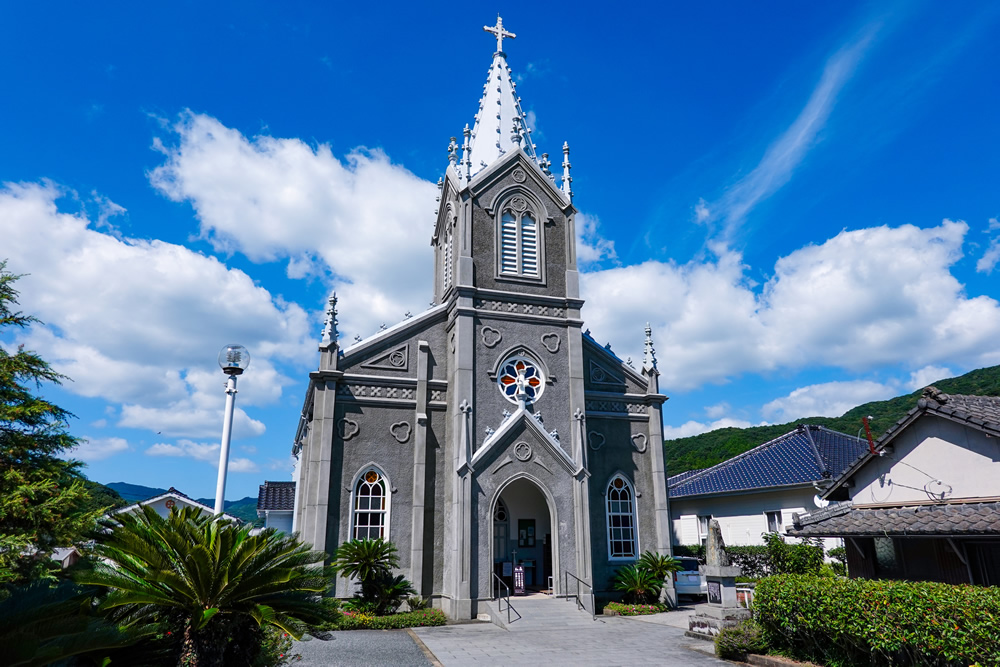
Sakitsu Village in Amakusa City, Kumamoto Prefecture, is famous for the Sakitsu Church, known as the “Church of the Sea.” The Hidden Christians in this fishing village maintained their faith while engaging in fishing.
Particularly noteworthy is how they skillfully wove their faith into daily life. They viewed the inner patterns of abalone shells as images of the Virgin Mary and developed unique prayer methods using shells collected from the sea.
In Sakitsu Village, a unique landscape can be observed where both a Buddhist shrine dedicated to the village Shinto deity and a Christian church coexist. This testifies to the history of Hidden Christians maintaining their faith while coexisting with existing religions.
The current Sakitsu Church, built in 1934, is a Gothic-style church building with the unique feature of having tatami mats installed on its interior floor, combining Japanese and Western styles. The location where the church stands is believed to be the former site of a village headman’s residence where picture trampling (iezumi) took place, making it a symbolic site of faith history.
4. Dejima Village in Sotokame (Nagasaki City)
Dejima Village in the Sotokame district of Nagasaki City is located in a remote area surrounded by cliff faces. This harsh natural environment served as a hiding place for Hidden Christians to maintain their faith.
Hidden Christians in Dejima Village combined agriculture and fishing while continuing their faith for approximately 250 years. The village preserves stone-built terraced fields and distinctive village landscapes reflecting the lifestyle of the Hidden Christian period.
After the freedom of faith in 1873, French missionary Father de Roquette came to this area and devoted himself to improving the lives of poor believers. The Dejima Church (built in 1882), designed by Father de Roquette, is known for its distinctive architectural style with a low roof and thick walls to withstand strong winds.
5. Ohno Village in Sotokame (Nagasaki City)
Ohno Village, also in the Sotokame district of Nagasaki City alongside Dejima Village, is another Hidden Christian village. This settlement is located even deeper in the mountains, with a location well-suited to avoiding external interference while maintaining faith.
The characteristic of Ohno Village is that the entire village functioned as a community of faith. Nearly all residents were Hidden Christians, and they supported each other while passing their faith to the next generation.
Father de Roquette constructed the Ohno Church in Ohno Village in 1893. This church, built using local stone, is simple yet robust, demonstrating Father de Roquette’s high level of architectural skill.
6. Kuroshima Village (Sasebo City)
Kuroshima, an island off the coast of Sasebo City, is a village formed by Hidden Christians who relocated from the Sotokame district. In the early 19th century, due to Omura Domain policy, many people relocated from the overcrowded Sotokame district to Kuroshima.
Hidden Christians on Kuroshima established their living foundation as pioneer farmers while secretly continuing their faith. The isolated island environment proved advantageous for concealing their faith.
After the freedom of faith, many believers on the island were discovered, and Kuroshima Cathedral was constructed in 1902. This church, built in Romanesque style with brick, is also called the “Great Cathedral of the Sea.” The church’s large scale relative to the island’s population attests to the importance of faith on this island.
7. Nozaki Island Settlement Remains (Ojika Town)
Nozaki Island in the northern Goto Islands is currently uninhabited, but was once home to a Hidden Christian village. In the early 19th century, people who relocated from the Sotokame district began pioneer life on this island under Omura Domain policy.
Hidden Christians on Nozaki Island developed terraced fields by cutting steep slopes and maintained their faith while living in a harsh natural environment. Deep in the island stands “Oki no Kamishima Shrine,” which Hidden Christians revered as a sacred site. Although it takes the form of a Shinto shrine, it is believed to have actually functioned as a Christian sacred site.
After the freedom of faith, the former Nozaki Church was built on the island in 1908. This brick church in a beautiful architectural style stands on high ground in the settlement and remains on the island today. However, due to depopulation, all island residents left in 1966, leaving only the church and settlement remains as witnesses to history.
8. Kashima Village Settlement (Shin-Kamigoto Town)
Kashima Island in the Goto Islands was also a Hidden Christian village formed by relocants from the Sotokame district. This island’s characteristic was that nearly all islanders were Christians.
Hidden Christians on Kashima Island made their living through slash-and-burn agriculture and fishing while protecting their faith as an entire community. The isolated island environment helped them avoid external surveillance.
The Kashima Cathedral, completed in 1910, is known as Japan’s only stone-built church. Its stone exterior walls, constructed from locally-quarried sandstone, and the beautifully decorated wooden ceiling inside are characteristic features. This church can be considered the crystallization of believers’ joy and gratitude after overcoming years of religious suffering.
9. Kuga Island Villages (Goto City)
Multiple Hidden Christian villages existed on Kuga Island in the Goto Islands. In 1868, a major persecution event called the “Goto崩れ” occurred on this island, and many believers were imprisoned, tortured, and approximately 200 are said to have been martyred.
Hidden Christians on Kuga Island remained steadfast in their faith despite such severe persecution. Settlements were scattered throughout the island, each forming a small faith community.
After the freedom of faith, multiple churches were built on Kuga Island. In particular, the former Gorio Church (built in 1881) is known as a valuable building preserving the characteristics of early church architecture.
10. Egami Village in Naru Island (Goto City)
Egami Village on Naru Island in the Goto Islands is a small fishing village facing an inlet. The Hidden Christians in this village are also descendants of relocants from the Sotokame district.
The characteristic of Egami Village was the village’s unity as a faith community. Residents engaged in fishing and agriculture while confirming their faith in one another and transmitting it to the next generation.
The Egami Cathedral, completed in 1918, is a simple yet beautiful wooden church. It is characterized by cream-colored exterior walls and light blue window frames that harmonize with the peaceful inlet landscape. This church was designated as a National Important Cultural Property in 2008.
Stone-built terraced fields evoking life during the Hidden Christian period are well preserved in the area around Egami Village.
11. Oura Cathedral (Nagasaki City)
Oura Cathedral, built in 1864, is the oldest existing Christian church building in Japan. This church was constructed by French missionaries and dedicated to the 26 Saints who were martyred in Nagasaki in 1597.
Oura Cathedral is important as a component asset of the World Heritage Site because it was the site of the “Discovery of Hidden Christians” that occurred on March 17, 1865. On this day, representatives of Hidden Christians from Urakami Village visited Oura Cathedral and confessed their Christianity to Father Petitjean.
This event became a historic incident that revealed to the world the existence of Hidden Christians who had maintained their faith for over 250 years without missionaries. The Pope is reported to have praised it as an “Oriental Miracle.”
Oura Cathedral is a beautiful Gothic-style building designated as a National Treasure in 1933 (currently designated as both National Treasure and World Heritage Site). Its interior is adorned with stained glass and an altar, creating a solemn atmosphere.
12. Other Related Assets in Nagasaki’s Sotokame District
In addition to the 11 primary component assets listed above, the entire Sotokame district is positioned as an important region telling the story of Hidden Christian history. The district preserves various facilities conveying the footsteps of Father de Roquette and cultural landscapes documenting life during the Hidden Christian period.
Visitor’s Guide to Hidden Christians Heritage Sites
Access Methods
The 12 component assets are scattered across a wide area of Nagasaki and Kumamoto prefectures, requiring a carefully planned itinerary to visit all of them.
Assets in Nagasaki City (Oura Cathedral, Sotokame District): Accessible from Nagasaki Airport or Nagasaki Station via route buses or rental cars. Oura Cathedral is located in central Nagasaki, a 5-minute walk from the “Oura Cathedral” stop on the streetcar line.
Assets in the Goto Islands: Travel to the Goto Islands by ferry or high-speed boat from Nagasaki Port. Using Fukue Island as a base, travel to each island by boat. Nozaki Island has no regular service, requiring chartered boat arrangements.
Hirado Assets: Travel to Hirado by bus from Sasebo Station. Rental cars or tourist buses are convenient for traveling around Hirado Island.
Sakitsu Village in Amakusa: Approximately 2.5 hours by car from Kumamoto City. Public transportation is limited, so rental cars are recommended.
Hara Castle Ruins: About 1 hour by car from Nagasaki Airport. Buses from Shimabara Railway “Shimabara Gaikō” station are also available.
Manners and Precautions for Visiting
Many component assets are currently used as places of worship or are villages where residents live. Please note the following when visiting:
Church Visit Etiquette: Interior visits to churches often require advance notice. Check the official website for confirmation. Inside churches, maintain silence and refrain from visiting during Mass or prayer times. Photograph only in permitted areas and avoid using flash.
Village Visit Etiquette: Villages are not tourist attractions but places of residence. Unauthorized entry to private property is strictly forbidden. Respect residents’ privacy and avoid loud conversations or noise.
Protection of Natural Environment: Many assets are located in nature-rich areas. Always take trash with you and avoid harvesting plants or actions that harm ecosystems.
Use of Guided Tours
For deeper understanding of Hidden Christian history and faith, accompanying professional guides is recommended. Certified guide tours are provided in various regions.
“World Heritage Pilgrimage Path” of Nagasaki and Amakusa: Officially designated pilgrimage routes where many guided tours are offered.
Goto Islands Church Tour: Local guides provide detailed explanation of island history and culture while visiting multiple churches.
Hirado Guided Walks: Tours offered by Hirado City Tourism Association, walking around sacred sites and villages.
Touring with guides provides understanding and emotion not gained through sightseeing alone.
Use of Area Walking Maps
Walking maps are provided at each component asset, allowing efficient touring of nearby attractions and related facilities. These maps are available from tourist information centers and official websites.
Faith and Culture of Hidden Christians
Oratio (Words of Prayer)
The words of prayer transmitted orally by Hidden Christians are called “Oratio” (オラショ). This word derives from the Latin “oratio” meaning prayer.
The characteristic of Oratio is that, over long years, the original Latin or Japanese prayers were transmitted as sound only, with meaning unknown to those reciting them. For example, “Ave Maria” became “anmennriya,” and “Santa Maria” became “santamariya,” changing into distinctive phonemes.
In the Goto Islands and Sotokame district, some elderly people still remember Oratio, and recording and preservation activities are conducted as valuable intangible cultural heritage.
Maria Kannon and Hidden Christian Implements
Hidden Christians devised various methods to conceal their faith. The most famous is “Maria Kannon,” viewing Buddhist Kannon statues as images of the Virgin Mary and revering them. While appearing to worship Kannon as a Buddhist believer, they secretly offered prayers to Mary.
Various other items were created as well, such as crosses hidden in Buddhist implements and everyday objects cleverly incorporating Christian symbols. These artifacts can be seen at facilities such as the “Nagasaki History and Culture Museum” and the “Hidden Christians Heritage Information Center.”
Picture Trampling and Trials of Faith
During the Edo period, the shogunate implemented “picture trampling” (絵踏) to ferret out Christians. This method required people to step on wooden plates depicting Christ or the Virgin Mary to prove they were not Christians.
Hidden Christians outwardly complied with picture trampling to protect their faith. However, they believed in their hearts that “God understands our suffering” and after stepping on the trampling pictures, secretly prayed for forgiveness of their sins.
This choice filled with anguish was depicted in Shusaku Endo’s novel “Silence,” becoming internationally known.
Initiatives After World Heritage Registration
Balance Between Preservation and Utilization
After World Heritage registration, tourism to component assets increased. While this has favorable aspects for local economies, issues of asset preservation and impact on residents’ living environments have also emerged.
Nagasaki Prefecture and related municipalities have formulated management plans emphasizing “balance between preservation and utilization.” Specific measures include implementing advance reservation systems for church visits, raising public awareness about tourism etiquette in villages, and addressing overtourism.
World Heritage Registration 5th Anniversary Projects
In 2023, to commemorate the 5th anniversary of World Heritage registration, various events such as the “Art Festival on Hidden Christians” were held. These projects help convey the value of heritage while contributing to regional cultural development.
Clean Walks and Community Contribution Activities
In cooperation with local residents and businesses, regular cleaning activities called “clean walks” around component assets are conducted. Donations from companies such as Aeon Kyushu Co., Ltd. are received, and asset preservation activities continue.
JR Kyushu Walking and the Pilgrimage Path
Walking events for the “World Heritage Pilgrimage Path” conducted in cooperation with JR Kyushu are also held, promoting heritage touring using railways. This represents a form of sustainable tourism visiting heritage while reducing environmental impact.
Facilities for Deeper Understanding of Hidden Christians Heritage
Hidden Christians Heritage Information Center of Nagasaki and Amakusa
The official information center in Nagasaki provides detailed information, historical background, and visiting guides for the 12 component assets. Exhibits and video materials are abundant, making it ideal as a starting point for heritage touring.
Local Museums and Historical Facilities
Nagasaki History and Culture Museum: Covering Nagasaki’s overall history, it displays numerous valuable Christian-related materials.
Minami-Takaki City Arima Christian Heritage Memorial Hall: Adjacent to the Hara Castle Ruins, it provides detailed exhibits on the Shimabara-Amakusa Rebellion.
Amakusa Christian Museum: Provides learning about Christian history in the Amakusa region, recommended to visit before and after touring Sakitsu Village.
Sotokame History and Folklore Museum: Allows detailed learning about the life and culture of Hidden Christians in the Sotokame district.
Goto City Fukue Island Church Group Museum: Teaches about Goto Islands Christian history and church architecture.
Conclusion: What the Hidden Christians Heritage Conveys
The Hidden Christians heritage sites of Nagasaki and Amakusa are not merely historical buildings or landscapes. They are living heritage conveying the story of over 250 years of suffering and hope, ingenuity and perseverance of people seeking freedom of faith.
Even under severe persecution, Hidden Christians did not completely abandon their faith, nor did they choose the path of martyrdom. Instead, they created unique forms of faith while coexisting with existing society. This spirit of “coexistence” offers important implications for considering contemporary multicultural coexistence societies.
The 12 component assets each tell different stories, illuminating different aspects of Hidden Christian history. The Hara Castle Ruins tell of the beginning of persecution, each village tells of ingenuity in maintaining faith, and Oura Cathedral tells of faith’s revival.
Visiting these heritage sites provides opportunity to consider universal values such as freedom of faith, human dignity, and cultural diversity, beyond merely learning history.
As a World Heritage Site, the Hidden Christians heritage sites of Nagasaki and Amakusa are precious cultural heritage for all humanity, to be passed on to future generations.