
Gusuku and Related Sites of the Ryukyu Kingdom, Okinawa Prefecture: World Heritage Complete Guide
What is Gusuku and Related Sites of the Ryukyu Kingdom?
“Gusuku and Related Sites of the Ryukyu Kingdom” is a cultural heritage registered on December 2, 2000, as Japan’s 11th World Heritage Site, located in Okinawa Prefecture. It is composed of a total of 9 historical sites: 5 gusuku (castle ruins) and 4 related sites scattered mainly in the southern part of Okinawa Main Island.
This World Heritage site is a precious collection of sites demonstrating the cultural and historical value of the Ryukyu Kingdom, which ruled the Ryukyu Islands from the 15th to the 19th century. As a symbol of Ryukyu culture that developed uniquely through trade with Japan, China, the Korean Peninsula, and Southeast Asian nations, it is highly evaluated internationally.
Background of World Heritage Registration
The registration of Gusuku and Related Sites of the Ryukyu Kingdom on the World Heritage list was decided at the 24th World Heritage Committee held in Cairns, Australia on November 30, 2000 (Central European Time). The official registration date is December 2, 2000.
In the registration process, the historical importance was evaluated of the Ryukyu Kingdom functioning as a bridge between East Asia and Southeast Asia for several centuries, fostering a unique culture. In particular, the fact that gusuku functioned not merely as military facilities but as centers of politics, economy, and religion, and that they continue to serve as spiritual anchors for local residents today, was highly praised.
The 9 Constituent Cultural Heritage Sites
The 9 cultural heritage sites constituting Gusuku and Related Sites of the Ryukyu Kingdom are classified into 5 gusuku (castle ruins) and 4 related sites. Each represents an important historical site demonstrating different aspects of the Ryukyu Kingdom.
5 Gusuku (Castle Ruins)
Nakijin Castle Ruins (nakijin-jo-ato)
Location: Nakijin Village, Kunigami District, Okinawa Prefecture
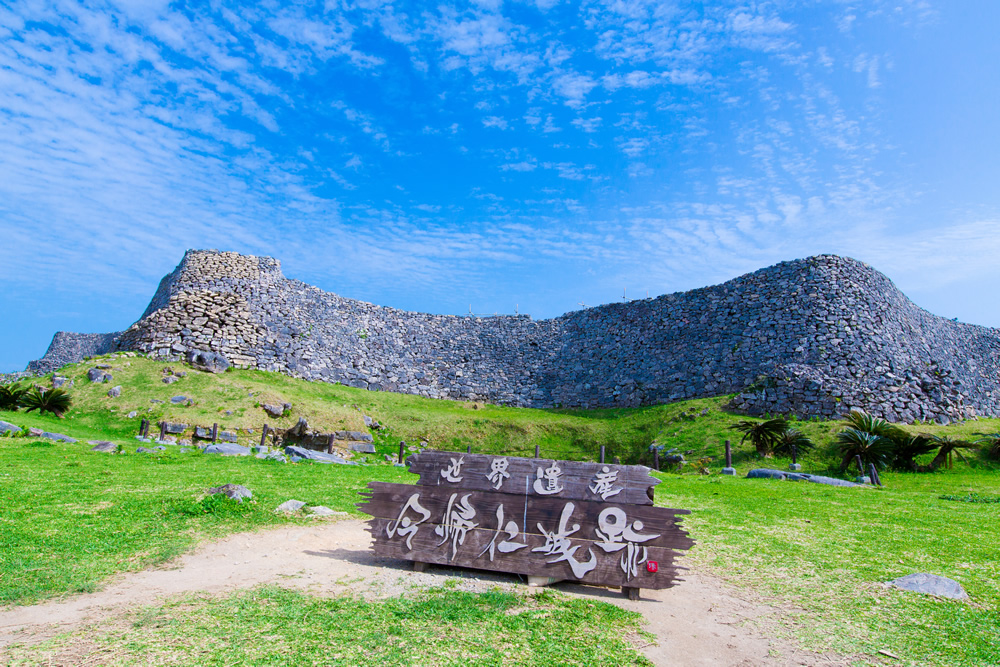
Nakijin Castle Ruins is the site of the residence of the King of the Northern Mountains before the unification of the Ryukyu Kingdom, located in the northern part of Okinawa Main Island. Said to have been built in the 14th century, the castle built on a hill approximately 100 meters above sea level is characterized by city walls extending approximately 1.5 kilometers in total length.
The castle walls were constructed using Ryukyu limestone with the natural stone stacking technique, skillfully utilizing the natural terrain with beautiful curved lines. Until it was taken by Shō Hashi, the King of the Middle Mountains, in 1416, it functioned as the political center of the Northern Mountains region. The castle ruins offer a panoramic view of the East China Sea and are also known for their beautiful landscape.
Zakimi Castle Ruins (zakimi-jo-ato)
Location: Yomitan Village, Nakagami District, Okinawa Prefecture
Zakimi Castle Ruins is a castle built in the early 15th century by Gusukuma, known as a master of castle construction. While relatively small in scale, its arch gate and sophisticated stone stacking technique are highly valued.
What deserves special mention is the castle gate said to be the oldest arch gate in Okinawa, featuring technically superior construction using wedge stones. The curve of the castle walls is beautiful, combining defensive function with aesthetic elements. The castle ruins are located on a hill approximately 120 meters above sea level and were a strategic location commanding the surrounding area.
Katsuren Castle Ruins (katsuren-jo-ato)
Location: Uruma City, Okinawa Prefecture
Katsuren Castle Ruins is a castle said to have been built between the 12th and 14th centuries, known for its last castle lord, Amamawari. Built on a hill approximately 100 meters above sea level, it has a unique structure with four enclosures arranged in a tiered formation.
From the castle, both the Pacific Ocean and the East China Sea can be viewed, and it played an important role as a base for overseas trade. Archaeological surveys have unearthed numerous ceramics from China and Southeast Asia, serving as evidence of the Ryukyu Kingdom’s international trade.
Nakagusuku Castle Ruins (nakagusuku-jo-ato)
Location: Nakagusuku Village and Kitanakagusuku Village, Nakagami District, Okinawa Prefecture
Nakagusuku Castle Ruins was built in the latter half of the 14th century by Saki Nakagusuku Anji and was enlarged and improved by Gusukuma in the 15th century. Composed of six enclosures, it is considered one of the gusuku that best retains its original form.
In the castle walls’ stone stacking, multiple techniques can be seen including natural stone stacking, regular stacking, and alternating stacking, demonstrating the developmental process of Ryukyu’s castle construction technology. When Commodore Perry’s expedition visited in 1853, they recorded the structure’s excellence. The spectacular view of the Pacific Ocean is also one of its attractions.
Shuri Castle Ruins (shuri-jo-ato)
Location: Naha City, Okinawa Prefecture
Shuri Castle Ruins is the site of the royal castle that functioned as the political, diplomatic, and cultural center of the Ryukyu Kingdom for approximately 450 years. Founded in the late 14th century, it served as the core of the kingdom until the Ryukyu Disposition in 1879.
The buildings, including the main hall, were known for their unique design combining Japanese, Chinese, and distinctly Ryukyuan architectural styles. Although the main hall and other structures were lost in a fire in October 2019, the World Heritage designation concerns “Shuri Castle Ruins” as underground archaeological remains, and its World Heritage value remains unchanged. Currently, efforts are underway toward restoration.
The castle ruins are located on a hill overlooking the Naha cityscape, with remains of stone walls, castle gates, and sacred sites still present. Excavations have confirmed the existence of structures from multiple periods in layers, making it an important archaeological site telling the story of the Ryukyu Kingdom’s history.
4 Related Sites
Sonohyan Utaki Ishimon (Sonohyan Sacred Gate) (sonohyan-utaki-ishimon)
Location: Naha City, Okinawa Prefecture (within Shuri Castle Ruins)
Sonohyan Utaki Ishimon is a stone gate made of Ryukyu limestone built in 1519. Located near the Shokakumon gate of Shuri Castle, it was a place of worship where the king prayed for safety when going out.
Approximately 2.5 meters high and 3 meters wide, this stone structure is a precious remains demonstrating Ryukyu’s unique religious worldview and architectural technique. Utaki refers to sacred sites in Ryukyuan beliefs, and this stone gate symbolically marks the entrance to the utaki. It is designated as an Important Cultural Property of Japan.
Tamaudun (Royal Mausoleum) (tamaudun)
Location: Naha City, Okinawa Prefecture
Tamaudun is a royal mausoleum of the Ryukyu royal family built in 1501 when King Shō Shin relocated his father King Shō En’s remains. Kings of the Second Shō Dynasty are interred here.
Built of Ryukyu limestone, it is a roof-style tomb divided into three burial chambers: the central chamber, eastern chamber, and western chamber. It is the largest roof-style tomb of the Ryukyu Kingdom, combining architectural styles influenced by China with distinctly Ryukyuan elements. In front of the tomb stands a stone monument called the “Tamaudun Inscription,” on which burial regulations are engraved. It is designated as an Important Cultural Property.
Shikina-en Garden (shikina-en)
Location: Naha City, Okinawa Prefecture
Shikina-en Garden is the largest separate residence of the Ryukyu royal family, constructed in the late 18th century. It was also used as a reception hall to entertain emissaries of the Chinese emperor, known as investiture envoys.
On a site of approximately 12,000 tsubo, a stroll garden centered on a pond spreads out. It possesses a unique style combining landscape architecture of Ryukyu, China, and Japan. The pond called Ikutoku Spring features islands of various sizes connected by stone bridges. Several structures including an octagonal pavilion and a red-tiled palace remain, demonstrating characteristics of Ryukyuan architecture. It is designated as a Special Place of Scenic Beauty of Japan.
Seifa Utaki (seefa-utaki)
Location: Nanjo City, Okinawa Prefecture
Seifa Utaki is the highest sacred site of the Ryukyu Kingdom. It is a sacred place appearing in Ryukyuan creation mythology, and the most prestigious location where the king himself came to pay his respects.
A sacred domain formed in Ryukyu limestone mountains, it contains multiple worship sites including Yorimanzu, Sankuri, and Daikuri. Particularly the Sankuri forms a mysterious space where giant rocks create a triangular shape, and from the gap, one can view Kume Island, considered the island of the gods. Today, it continues to function as a living place of faith where many people offer their prayers.
World Heritage Registration Criteria
Gusuku and Related Sites of the Ryukyu Kingdom were registered as meeting the following three criteria established by UNESCO for World Heritage designation.
Registration Criterion (ii): Evidence of Cultural Exchange
The Ryukyu Kingdom developed its unique culture through active trade and exchange with Japan, China, the Korean Peninsula, and Southeast Asian nations. Gusuku and related heritage sites are important evidence of cultural exchange and mutual influences between these regions.
In architectural styles, stone stacking techniques, and garden design, elements influenced by China and Japan are visible while maintaining distinctly Ryukyuan characteristics. Furthermore, excavated artifacts such as ceramics testify to the existence of an extensive trade network.
Registration Criterion (iii): Evidence of Cultural Tradition
Gusuku and Related Sites of the Ryukyu Kingdom are excellent evidence of the unique traditions of Ryukyuan culture that flourished between the 12th and 19th centuries.
Gusuku functioned not merely as military facilities but as centers of politics, economy, and religion, reflecting the structure of Ryukyuan society. Furthermore, religious facilities such as utaki are precious cultural heritage transmitting the Ryukyuan belief system to the present day. These continue to function as spiritual pillars for local residents today, holding value as living cultural heritage.
Registration Criterion (vi): Association with Events or Traditions of Universal Significance
Gusuku and Related Sites of the Ryukyu Kingdom are closely linked to the Ryukyuan belief system unique to Ryukyu. Utaki faith in particular is an important spiritual tradition forming the foundation of Ryukyuan culture and remains the object of faith for many people today.
Sacred sites including Seifa Utaki are deeply connected to Ryukyuan creation mythology and the legitimacy of royal authority, symbolizing the identity of Ryukyuan culture. These places continue to be objects of prayer and veneration today, functioning as living heritage with intangible cultural value.
Historical Background and Characteristics of Gusuku
What is Gusuku?
“Gusuku” is a Ryukyuan word referring to stone fortress castles found in Okinawa and the Amami Islands. An estimated 200 to 300 gusuku exist within Okinawa Prefecture, of which 5 are registered as World Heritage sites.
From around the 12th century, gusuku were built by local warlords called aji as their residences and defensive bases. They functioned not merely as military facilities but as centers of politics, economy, and religion, and as symbols of local communities, serving multiple roles.
Architectural Characteristics of Gusuku
The greatest characteristic of gusuku is the sophisticated stone stacking technique using Ryukyu limestone. The following are the main stacking techniques employed.
Natural Stone Stacking: The oldest technique of stacking natural stones as they are, seen at sites like Nakijin Castle Ruins.
Regular Stacking: The technique of stacking stones aligned horizontally, requiring more advanced skill.
Alternating Stacking: The technique of stacking a combination of large and small stones, combining strength with aesthetic appeal.
Furthermore, castle walls are designed to describe curves rather than straight lines, which heightens defensive function while creating aesthetically pleasing effects. Arch gate technology is also characteristic, and the arch gate at Zakimi Castle Ruins is said to be the oldest in Okinawa.
The Establishment of the Ryukyu Kingdom and the Role of Gusuku
From the 14th to the 15th centuries, the Ryukyu Islands were divided among three powers (the Three Kingdoms period): the Northern Mountains, Central Mountains, and Southern Mountains. In 1429, Shō Hashi of the Central Mountains unified the three kingdoms, establishing the Ryukyu Kingdom.
After unification, many gusuku lost their military function and changed their roles to become administrative centers or places of faith for regions. Shuri Castle was developed as the center of the kingdom and assumed central functions of politics, diplomacy, and culture.
The Ryukyu Kingdom prospered through trade between East and Southeast Asia as the axis of its tributary relationship with China (Ming and Qing). This role as “Bridge of All Nations” (bankoku shintai) in connecting the world became the foundation for nurturing Ryukyuan culture.
The Cultural Uniqueness of the Ryukyu Kingdom
Center of East Asian Cultural Exchange
The Ryukyu Kingdom, positioned geographically between Japan, China, and Southeast Asia, entered the “Great Age of Trade” from the 15th to 16th centuries. It prospered as an international trade hub relaying Chinese silk and ceramics, Japanese swords, and Southeast Asian spices.
Through this trade, various cultures flowed into Ryukyu, where they were refined into a unique culture. In all fields—architecture, performing arts, crafts, and cuisine—culture formed that bore distinctly Ryukyuan characteristics while being influenced by multiple cultures.
Ryukyu’s Unique Belief System
Ryukyuan religion possesses a unique belief system based on nature worship. Faith centered on sacred sites called utaki (utaki) became the spiritual foundation of Ryukyuan culture.
Distinctive is the “Noro” system, in which women held religious authority. The highest-ranking priestess, the Kikoe Okimi (Great Heavenly Deity Authorizer), was appointed from among the king’s sisters and presided over national rituals. The enthronement ceremony at Seifa Utaki was an important ritual demonstrating royal legitimacy.
This belief system is rooted in contemporary local society, with prayers continuing to be offered at many utaki. The fact that World Heritage constituent assets function as living places of faith rather than mere historical structures is an important element demonstrating the continuity of Ryukyuan culture.
Characteristics of Ryukyuan Architecture
Ryukyuan architecture, influenced by China, Japan, and Southeast Asia, established its own unique style.
Red Tiles: Red tiles symbolizing Ryukyuan architecture were influenced by southern China. In response to the typhoon-prone climate, techniques of fixing tiles with plaster developed.
Stone Walls: Curved stone walls using Ryukyu limestone combine functionality with aesthetics, representing Ryukyuan unique technology.
Wooden Architecture: Architectural styles fusing Chinese decorative elements with Japanese structure, as seen in the main hall of Shuri Castle, demonstrate the uniqueness of Ryukyuan architecture.
Gardens: Ryukyuan gardens, exemplified by Shikina-en, influenced by southern Chinese gardens while maintaining a distinctive style adapted to Ryukyu’s natural environment.
Access and Tourism Information for Each Constituent Asset
Heritage Sites in Naha City (Shuri Castle Ruins, Sonohyan Utaki Ishimon, Tamaudun, Shikina-en)
Shuri Castle Ruins and Sonohyan Utaki Ishimon
- Access: About 15 minutes’ walk from Yui Rail “Shuri Station,” or by bus
- Opening Hours: 8:00 am-7:30 pm (hours vary seasonally)
- Note: The main hall was destroyed in a fire in 2019; restoration work is ongoing
Tamaudun
- Access: About 5 minutes’ walk from Shuri Castle
- Viewing Hours: 9:00 am-6:00 pm
- Viewing Fee: Adults 300 yen
Shikina-en
- Access: About 20 minutes by bus from Yui Rail “Shuri Station”
- Opening Hours: 9:00 am-5:30 pm (5:00 pm from October-March)
- Admission: Adults 400 yen
Heritage Sites in the Central Region (Zakimi Castle Ruins, Nakagusuku Castle Ruins, Katsuren Castle Ruins)
Zakimi Castle Ruins
- Access: About 60 minutes by bus from Naha Bus Terminal
- Viewing: Free access
- Admission: Free
Nakagusuku Castle Ruins
- Access: About 40 minutes by car from Naha
- Opening Hours: 8:30 am-5:00 pm (6:00 pm from May-September)
- Admission: Adults 400 yen
Katsuren Castle Ruins
- Access: About 50 minutes by car from Naha
- Viewing: Free access
- Admission: Free
- Note: “Amawaripark,” a historical and cultural facility with a rest area, opened in 2019
Heritage Sites in Northern and Southern Areas (Nakijin Castle Ruins, Seifa Utaki)
Nakijin Castle Ruins
- Access: About 90 minutes by car from Naha, or by express bus
- Opening Hours: 8:00 am-6:00 pm (hours vary seasonally)
- Admission: Adults 600 yen
- Note: Famous as a cherry blossom viewing spot from late January to early February
Seifa Utaki
- Access: About 40 minutes by car from Naha, or by bus
- Viewing Hours: 9:00 am-6:00 pm (5:30 pm from November-February)
- Admission: Adults 300 yen
- Note: As a sacred site, respectful behavior is required. There may be entry restrictions on ritually significant days in the lunar calendar
Efforts for Preservation and Transmission
Current Status of Cultural Property Protection
The constituent assets of Gusuku and Related Sites of the Ryukyu Kingdom are designated respectively as National Historic Sites, Important Cultural Properties, and Special Places of Scenic Beauty, and are strictly protected under the Cultural Properties Protection Law.
Okinawa Prefecture and each municipality have formulated preservation and management plans for the heritage and carry out regular inspections, restoration, and environmental improvements. Measures to prevent stone wall collapse, vegetation management, and drainage equipment improvements are implemented in harmony with the natural environment.
Reconstruction After the Shuri Castle Fire
The October 31, 2019 fire destroying Shuri Castle’s main hall and other buildings was a major shock not only to Okinawa residents but to people throughout Japan and the world. However, the World Heritage designation concerns “Shuri Castle Ruins” as underground archaeological remains, and the World Heritage value is not diminished.
Currently, the national government and Okinawa Prefecture are proceeding with restoration work aimed at completing the main hall by 2026. In the restoration process, detailed records of the building before the fire and the use of traditional techniques and materials are being prioritized. Enhanced fire prevention measures reflecting lessons from the fire are also being implemented.
Cooperation with Local Communities
Preserving World Heritage requires the understanding and cooperation of local residents. In particular, utaki such as Seifa Utaki function as places of faith for local communities today, and harmony with the local community is essential.
In various regions, educational programs using World Heritage and training of community guides are being conducted. Sustainable heritage utilization is being explored while balancing tourism and faith, and preservation.
International Cooperation and Technical Exchange
Cooperation with international organizations such as UNESCO and the International Council on Monuments and Sites (ICOMOS) promotes improvement of preservation techniques and information exchange. Technical exchange is also being advanced with regions possessing stone structures using Ryukyu limestone.
The History of the Ryukyu Kingdom and the Significance of World Heritage
450 Years of Ryukyu Kingdom History
The history of the Ryukyu Kingdom spans approximately 450 years from the 1429 unification of the Three Kingdoms by Shō Hashi until the Ryukyu Disposition (establishment of Okinawa Prefecture) in 1879.
First Shō Dynasty Era (1429-1469): The dynasty established by Shō Hashi established tributary relations with China and expanded trade with Southeast Asia.
Second Shō Dynasty Era (1470-1879): The dynasty founded by Shō En saw the Ryukyu Kingdom’s height. From the 16th century, the “Great Age of Trade” was experienced, a period of greatest cultural development.
After the 1609 Satsuma Domain invasion, the Ryukyu Kingdom maintained formal independence and continued relations with China. This “dual-monarchies” position of maintaining relations with both Japan and China became a factor in preserving Ryukyuan culture.
The Universal Value Presented by World Heritage
The primary reason the Gusuku and Related Sites of the Ryukyu Kingdom was recognized as a World Heritage site is the uniqueness and universality of Ryukyuan culture.
The history of the Ryukyu Kingdom, a small island nation that skillfully conducted diplomacy and trade with surrounding great powers and developed its unique culture, holds world-class value demonstrating the importance of cultural diversity and exchange.
Furthermore, the fact that gusuku and utaki continue to function as spiritual anchors for local communities today demonstrates that cultural heritage is not merely a relic of the past but living heritage continuous with contemporary society.
Okinawa’s Identity and World Heritage
The World Heritage registration became an opportunity for Okinawa residents to reaffirm their cultural identity. The international recognition of Ryukyu Kingdom history and culture was an important occasion confirming Okinawa’s uniqueness and pride.
Simultaneously, World Heritage plays an important role as a tourism resource. Millions of tourists visit annually, contributing significantly to the Okinawa economy. However, balancing tourism development with heritage preservation remains an ongoing challenge.
Precautions and Etiquette When Visiting World Heritage Sites
Respect as Sacred Sites
Particularly utaki such as Seifa Utaki are sacred sites that continue to be objects of faith today. Please understand they are simultaneously tourist destinations and places of prayer, keeping the following points in mind:
- Refrain from loud conversation or loud behavior
- Be cautious about photography at worship sites (photography is prohibited at some sites)
- Entry may be restricted on days when rituals are being conducted
- Be mindful of appropriate dress and behavior befitting the sacred nature
Cooperation in Heritage Preservation
World Heritage is the shared property of humanity, and we bear responsibility for transmitting it to future generations.
- Do not climb on or touch stone walls or remains
- Do not enter areas outside designated pathways
- Always take trash with you
- Do not remove plants or stones
- Graffiti and destructive acts are strictly prohibited
Efficient Viewing Plans
The 9 constituent assets are scattered widely across Okinawa Main Island from the south to the north. Viewing all in one day is difficult, so planning across multiple days is recommended.
Naha Vicinity Course (1 day): Shuri Castle Ruins, Sonohyan Utaki Ishimon, Tamaudun, Shikina-en, Seifa Utaki
Central Region Course (Half day-1 day): Zakimi Castle Ruins, Nakagusuku Castle Ruins, Katsuren Castle Ruins
Northern Region Course (Half day or more): Nakijin Castle Ruins
A rental car is most convenient, but bus, taxi, and organized tour options are also available.
Conclusion: The Cultural Value Conveyed by Ryukyu Kingdom Heritage
Gusuku and Related Sites of the Ryukyu Kingdom is not merely a collection of historical structures. It is a precious witness to the 450-year history of the Ryukyu Kingdom—a small island nation that nurtured its unique culture despite being surrounded by great powers and prospered as a bridge between East and Southeast Asia.
The five gusuku demonstrate Ryukyu’s political and military history while conveying sophisticated stone stacking techniques and aesthetic sensibilities to the present. The four related sites present diverse aspects of the Ryukyu Kingdom’s history, including its religious worldview, royal symbolism, and international exchange.
The 2000 World Heritage registration of these heritage sites signifies international recognition of Ryukyuan culture’s uniqueness and universal value. Ryukyuan culture, born where Japanese, Chinese, and Southeast Asian cultures intersect, carries a global message of the importance of cultural diversity and exchange.
Although the 2019 Shuri Castle fire was a significant loss, the essential value of the World Heritage lies in underground archaeological remains, and that value is undiminished. Reconstruction efforts demonstrate pride in Ryukyuan culture and determination to preserve it.
Visiting Gusuku and Related Sites of the Ryukyu Kingdom carries meaning beyond mere tourism. It is an opportunity to learn the process of how different cultures encounter, fuse, and create new culture, and an occasion to reaffirm the importance of peaceful exchange and mutual understanding.
When visiting Okinawa, please be sure to visit these World Heritage sites and touch the depth of Ryukyu Kingdom history and culture. And to transmit these precious heritage sites to future generations, we are each called upon to consider the balance between preservation and utilization, and to approach them with respect.