Amami Oshima, Tokuno Island, Northern Okinawa Island, and Iriomote Island: A Complete Guide to Kagoshima Prefecture’s World Natural Heritage
Introduction: Japan’s 5th World Natural Heritage
On July 26, 2021, “Amami Oshima, Tokuno Island, Northern Okinawa Island, and Iriomote Island” were officially registered as Japan’s 5th World Natural Heritage. With this registration, Kagoshima Prefecture became the only prefecture in Japan to possess two World Natural Heritage sites, following Yakushima. This heritage, which includes Amami Oshima and Tokuno Island, has been recognized as a globally valuable biodiversity hotspot where rare endemic species such as the Amami rabbit inhabit.
This article provides a comprehensive explanation of the full picture of the World Natural Heritage “Amami Oshima, Tokuno Island, Northern Okinawa Island, and Iriomote Island,” centered on Amami Oshima and Tokuno Island, which Kagoshima Prefecture takes pride in. It covers the history of registration, characteristics of the natural environment, endemic species, conservation efforts, and sustainable tourism practices.
History and Background of World Natural Heritage Registration
The Long Road to Registration
The World Natural Heritage registration of Amami Oshima, Tokuno Island, Northern Okinawa Island, and Iriomote Island did not come about through a single application. It took 18 years from when the Ministry of the Environment and the Forestry Agency began examining candidate sites for World Natural Heritage in 2003 (Heisei 15).
Major milestones:
- 2003 (Heisei 15): The Ministry of the Environment and the Forestry Agency began examining World Natural Heritage candidate sites
- 2013 (Heisei 25): “Amami-Ryukyu” was selected as a World Natural Heritage candidate site
- 2017 (Heisei 29): The initial nomination document was submitted to UNESCO
- 2018 (Heisei 30): IUCN (International Union for Conservation of Nature) issued a “deferred” recommendation and the nomination was withdrawn
- 2019 (Heisei 31/Reiwa 1): The nomination scope was revised and a revised nomination document was submitted
- May 2021 (Reiwa 3): IUCN issued an “inscription” recommendation
- July 26, 2021 (Reiwa 3): Official registration was decided at the 44th World Heritage Committee Plenary Session
Re-challenge After Deferral
The IUCN’s 2018 “deferred” recommendation pointed out issues with the scope of the proposed site and management framework. In response, Kagoshima Prefecture and the Ministry of the Environment revised the scope of the nomination, expanded the buffer zone, and constructed a more robust conservation management system. This careful approach led to the successful registration in 2021.
Composition and Characteristics of the Heritage Area
Four Islands, Five Components
“Amami Oshima, Tokuno Island, Northern Okinawa Island, and Iriomote Island” comprises four regions: Amami Oshima and Tokuno Island in the Central Ryukyus, Northern Okinawa Island, and Iriomote Island in the Southern Ryukyus. The total area spans approximately 42,698 hectares.
Breakdown of components:
- Amami Oshima (Kagoshima Prefecture): approximately 11,640 hectares
- Tokuno Island (Kagoshima Prefecture): approximately 2,506 hectares
- Northern Okinawa Island (Okinawa Prefecture): approximately 7,721 hectares (Kunigami Village, Ogimi Village, Higashi Village)
- Eastern Iriomote Island (Okinawa Prefecture): approximately 4,787 hectares
- Western Iriomote Island (Okinawa Prefecture): approximately 16,044 hectares
Geographic and Geological Background
The Ryukyu Islands, which include Amami Oshima and Tokuno Island, repeatedly became connected to and separated from the continent over a period of approximately 2 million years. This geological history of repeated isolation and connection has been a major factor in producing numerous endemic species that have undergone unique evolution.
Amami Oshima in Kagoshima Prefecture has an area of approximately 712 square kilometers, and Tokuno Island has an area of approximately 248 square kilometers. Both belong to a subtropical climate zone with an average annual temperature of approximately 21 degrees Celsius and annual precipitation of 2,000 to 3,000 millimeters, creating a warm and humid environment that nurtures rich subtropical evergreen broadleaf forests.
Kagoshima Prefecture’s Two World Natural Heritage Sites
Yakushima and Amami: Two Heritages with Different Charms
Kagoshima Prefecture, following the registration of Yakushima in 1993, became Japan’s only prefecture to possess two World Natural Heritage sites with the registration of Amami Oshima and Tokuno Island.
Differences between Yakushima and Amami:
- Yakushima: Characterized by vertically distributed vegetation, Yakushima cedar trees thousands of years old, and mountainous topography
- Amami Oshima and Tokuno Island: Characterized by subtropical evergreen broadleaf forests, endemic mammals, reptiles and amphibians, and biodiversity
These two World Natural Heritage sites each possess distinct natural value and symbolize the richness and diversity of Kagoshima Prefecture’s nature.
Natural Environment and Endemic Species of Amami Oshima
A Treasure Trove of Subtropical Evergreen Broadleaf Forest
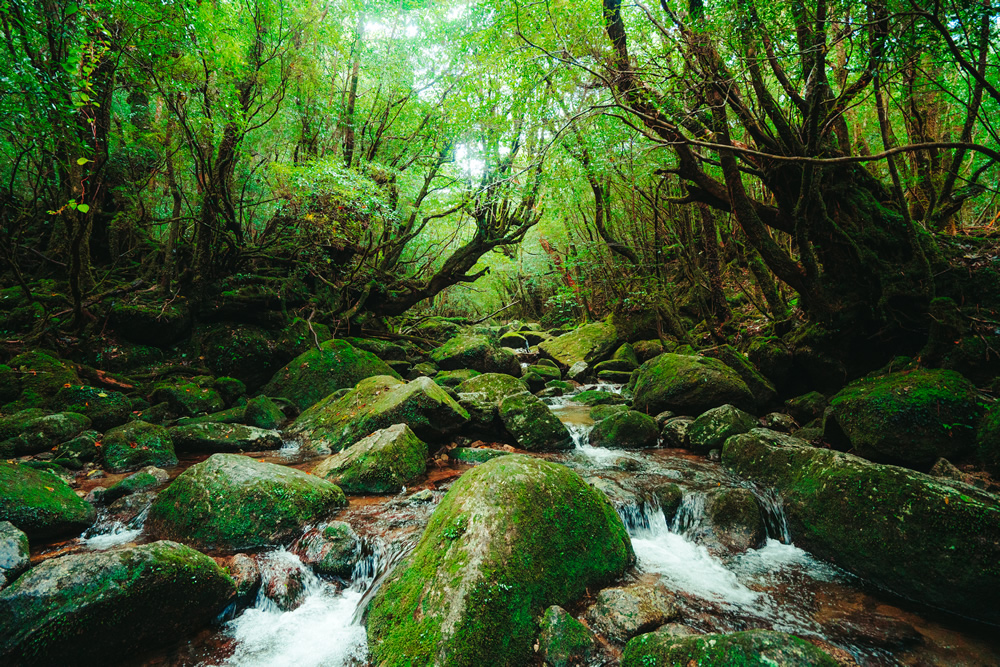
Amami Oshima is covered with Japan’s largest subtropical evergreen broadleaf forest. Dense stands of evergreen broadleaf trees such as Japanese chinkapin, winter-blooming camellia, and Okinawa cork oak, with large fern plants such as tree ferns flourishing on the forest floor, create a unique forest landscape. This forest is maintained year-round by a warm and humid climate and serves as a habitat for diverse organisms. The forest has a well-developed hierarchical structure, with specific organisms inhabiting each layer: the canopy layer, subcanopy layer, shrub layer, and herbaceous layer.
Amami Rabbit: Symbol of a Globally Rare Species
The Amami rabbit (Pentalagus furnessi) is a Japanese endemic species inhabiting only Amami Oshima and Tokuno Island, and is an extremely rare primitive rabbit species from a global perspective.
Characteristics of the Amami rabbit:
- Body length 40–50 centimeters, body weight 2–3 kilograms
- Short ears and short limbs with a primitive morphology
- Nocturnal, digging burrows in the forest floor for habitation
- Designated as a Special Natural Monument of Japan, listed as Endangered (EN) on the IUCN Red List
- Estimated population: approximately 10,000 individuals on Amami Oshima, approximately 2,000 on Tokuno Island
The Amami rabbit has faced threats from predation by invasive species such as mongooses and feral cats, as well as traffic accidents. However, conservation efforts have resulted in a recent upward trend in population numbers.
Other Endemic Mammals
Besides the Amami rabbit, Amami Oshima is home to other valuable endemic mammals.
Amami spiny rat: An endemic rodent of Amami Oshima with spiny hairs on its back
Long-haired rat: A large rodent inhabiting Amami Oshima, Tokuno Island, and Northern Okinawa Island
Ryukyu wild boar (Amami subspecies): A smaller subspecies than wild boars on the mainland
These endemic mammals represent species that have undergone unique evolution due to long-term isolation from the continent and are biologically valuable.
Diversity of Birds
Approximately 230 bird species have been recorded on Amami Oshima, including many endemic species and subspecies.
Major endemic species and subspecies:
- Okinawa woodpecker: An endemic woodpecker of Amami Oshima, designated as a Natural Monument of Japan
- Amami woodcock: An endemic subspecies inhabiting Amami Oshima and Tokuno Island
- Lidth’s jay: An endemic bird of Amami Oshima with beautiful blue coloring, designated as the prefectural bird
- White’s thrush: An Amami Oshima endemic subspecies, known for its beautiful call
These birds serve as important indicators of forest ecosystem health.
Endemic Reptiles and Amphibians
Amami Oshima is also a treasure trove of endemic reptile and amphibian species.
Major endemic species:
- Amami tip-nosed frog: A large endemic frog of Amami Oshima
- Otton’s frog: A large frog inhabiting Amami Oshima and Kakeromajima Island
- Amami dark-spotted frog: One of Japan’s most beautiful frogs
- Habu: A venomous snake inhabiting Amami Oshima, one of the apex predators in the ecosystem
- Amami green snake: A non-venomous, beautifully green snake
These amphibians and reptiles serve as important research subjects for understanding the evolutionary process in island ecosystems.
Diversity of Insects
Amami Oshima is home to over 2,000 insect species, many of which are endemic.
Representative endemic species:
- Amami flat-horned beetle: A large endemic stag beetle of Amami Oshima
- Yanba long-horned beetle: A rare species that also inhabits Amami Oshima
- Amami pseudo-scorpion: A primitive organism belonging to the subphylum Chelicerata
Insects play important roles in plant pollination and material cycling, making them indispensable to forest ecosystem maintenance.
Natural Environment and Endemic Species of Tokuno Island
Geography and Nature of Tokuno Island
Tokuno Island is located approximately 60 kilometers southwest of Amami Oshima and covers an area of approximately 248 square kilometers. Its highest peak is Iinokawa (645 meters above sea level), with mountains extending from the central to northern parts of the island, retaining rich subtropical evergreen broadleaf forests. The heritage area of Tokuno Island covers approximately 2,506 hectares, mainly including the forest area in the central to northern parts of the island. This area serves as an important habitat for rare endemic species including the Amami rabbit.
Endemic and Rare Species of Tokuno Island
Tokuno Island is home to many endemic species shared with Amami Oshima, but also has characteristics unique to Tokuno Island.
Major endemic species and rare species:
- Amami rabbit: The Tokuno Island population is estimated at approximately 2,000 individuals, and is genetically slightly different from the Amami Oshima population
- Tokuno spiny rat: An endemic rodent of Tokuno Island, extremely rare
- Long-haired rat: Also inhabits Tokuno Island
- Obi two-toed skink: A primitive lizard species inhabiting Tokuno Island and the Ryukyu Islands
Since Tokuno Island has a smaller area than Amami Oshima, its population numbers are limited, requiring more concentrated conservation efforts.
Conservation Activities on Tokuno Island
On Tokuno Island, local residents, administration, and researchers cooperate in conservation activities.
Main initiatives:
- Feral cat countermeasures: In response to the problem of feral cats preying on Amami rabbits, capture-and-transfer programs are being implemented
- Traffic accident prevention: Nighttime reduced-speed driving campaigns and warning signs
- Habitat conservation: Restrictions on forest logging, removal of invasive plants
- Environmental education: Nature conservation education for local children
Through these efforts, the Amami rabbit population on Tokuno Island has shown an upward trend in recent years.
Evaluation Criteria for World Heritage Registration and Outstanding Universal Value
Evaluation Criteria
“Amami Oshima, Tokuno Island, Northern Okinawa Island, and Iriomote Island” was registered as meeting criterion (x) “Biodiversity” among the natural heritage evaluation criteria of the World Heritage Convention.
Criterion (x) Biodiversity:
“Contains the most important and significant natural habitats for in-situ conservation of biological diversity, including those containing threatened species of outstanding universal value from the point of view of science or conservation.”
Outstanding Universal Value (OUV)
The heritage area, including Amami Oshima and Tokuno Island, has been recognized as having outstanding universal value for the following reasons.
1. Diversity and Density of Endemic Species
The heritage area is home to 95 endangered species (listed on the IUCN Red List), many of which are endemic. Particularly, the endemism rate of terrestrial mammals is extremely high, making it a rare location from a global perspective.
2. Living Evidence of Evolutionary Processes
Organisms that have undergone unique evolution through the history of isolation from and reconnection to the continent exist in the region, making it extremely important for research in island biogeography and evolutionary biology.
3. Integrity of Ecosystems
The ecosystem centered on subtropical evergreen broadleaf forests is well preserved, with each hierarchical level of the ecosystem, from apex predators to decomposers, functioning properly.
Kagoshima Prefecture’s Conservation Management System
Regional Cooperative Conservation Activity Plan
Kagoshima Prefecture has established the “Amami Oshima, Tokuno Island, Northern Okinawa Island, and Iriomote Island World Natural Heritage Regional Liaison Conference” in cooperation with the Ministry of the Environment, the Forestry Agency, and local municipalities (Amami City, Yamato Village, Uken Village, Setouchi Town, Ryukyo Town, Amagiyazaki Town, Tokuno Island Town, Ijin Town).
This conference deliberates and coordinates on the following matters:
- Conservation management of heritage areas and buffer zones
- Invasive species countermeasures
- Tourism management
- Monitoring system
- Public awareness activities
Kagoshima Prefecture’s Initiatives
Kagoshima Prefecture is promoting the following measures for the conservation and sustainable use of Amami Oshima and Tokuno Island.
1. Rare Species Protection
- Monitoring habitat status of Amami rabbits and other species
- Traffic accident prevention measures (warning signs, speed regulations)
- Feral cat countermeasures (TNR activities, proper management of pet cats)
2. Invasive Species Countermeasures
- Continued capture activities toward complete eradication of mongooses
- Removal of invasive plants (Acmella oleracea, Albizia lebbeck, etc.)
- Prevention of new invasive species introductions
3. Forest Conservation
- Logging restrictions on national and prefectural forests
- Forest road management and appropriate use
- Forest fire prevention measures
4. Environmental Education and Public Awareness
- Exhibitions and information provision at the World Natural Heritage Center (Amami City)
- Environmental learning programs in school education
- Training and certification system for eco-tour guides
Sustainable Tourism and Regional Revitalization
Tourism Trends After World Heritage Registration
Following the World Natural Heritage registration, the number of tourists visiting Amami Oshima and Tokuno Island has been on an upward trend. However, increased tourist numbers also lead to increased environmental burden, making the realization of sustainable tourism an important issue.
Promotion of Ecotourism
Kagoshima Prefecture and local municipalities are promoting ecotourism that considers the natural environment.
Main initiatives:
1. Certified Eco-tour Guide System
The Amami Islands Eco-tour Guide Liaison Council certifies guides meeting certain standards and promotes the provision of high-quality eco-tours. Certified guides receive training in nature conservation knowledge, safety management, and understanding of local culture.
2. Setting Usage Rules
- Restrictions on nighttime forest entry (in certain areas)
- Prohibition of feeding wildlife
- Complete removal of trash
- Restrictions on entry outside designated trails and hiking routes
3. Tourism Facility Development
- Information provision at the World Natural Heritage Center (Amami Wildlife Protection Center)
- Appropriate parking and toilet facilities
- Multilingual signage
Walking Through Amami Forest: Recommended Eco-tours
Various eco-tours are offered on Amami Oshima and Tokuno Island.
Popular eco-tours:
1. Night Tours
Walking through the night forest with a certified guide to observe nocturnal wildlife such as Amami rabbits and Amami tip-nosed frogs. The guide instructs on proper light use and observation etiquette to minimize impact on wildlife.
2. Kanakubare Primeval Forest Trekking
A tour of Kanakubare Primeval Forest, a representative subtropical evergreen broadleaf forest on Amami Oshima. Giant tree ferns and diverse plants can be observed. ※Currently, vehicle entry to Kanakubare Primeval Forest requires an accompanying certified guide.
3. Mangrove Canoeing
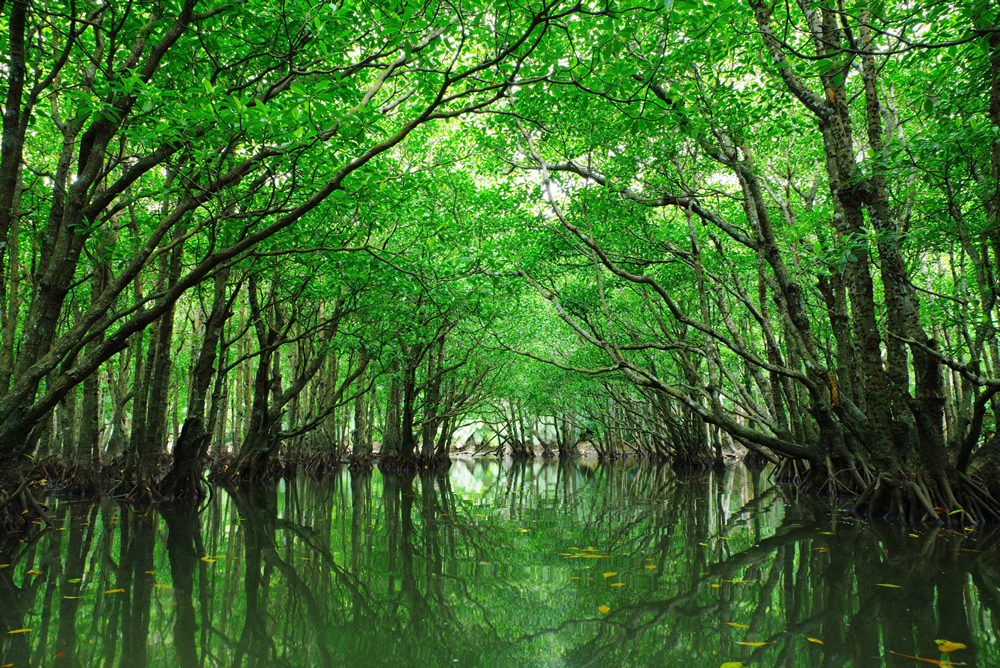
A tour exploring Amami Oshima’s mangrove forest by canoe, offering observation of mudflat organisms and learning about mangrove ecology.
4. Birdwatching
Early morning forest tours to observe endemic species such as Lidth’s jays and Okinawa woodpeckers.
Coexistence with Regional Culture
The nature of Amami Oshima and Tokuno Island is closely connected with regional culture.
Living Based on “Environmental Culture”
The people of Amami have long cultivated an “environmental culture” of coexistence with nature.
- Shima (village) nature use: Sustainable use of mountains and seas belonging to each village
- Yui (mutual assistance): Communal forest management and agricultural land conservation
- Reverence for nature: Protection of sacred forests (utaki), gratitude toward nature
This environmental culture continues in modern conservation activities and serves as the foundation for resident-led conservation efforts.
Next-Generation Heritage Project
Kagoshima Prefecture and local municipalities are implementing various projects to pass the World Natural Heritage on to future generations.
Main projects:
1. Children’s Nature Experience Program
Forest experience, wildlife observation, and environmental education programs for local elementary and middle school students. Building understanding of local nature’s value and fostering conservation consciousness.
2. World Heritage Junior Guide Training
A program training high school students to learn about the World Heritage’s value and conservation, enabling them to explain it to tourists.
3. Community Resident Workshops
Workshops where local residents discuss post-registration tourism approaches and the balance between nature conservation and regional development.
4. Collaboration with Researchers
Collaboration with universities and research institutions for biological monitoring and ecosystem research. Promoting science-based conservation management.
Issues and Future Prospects
Current Challenges Facing the Region
The World Natural Heritage registration has brought new challenges to Amami Oshima and Tokuno Island.
1. Increased Tourism Pressure
Post-registration tourism growth has shown signs of overtourism at some popular spots. Appropriate usage management and dispersal are needed.
2. Continuing Invasive Species Problem
Although mongoose populations have declined significantly, complete eradication has not been achieved. Feral cat problems remain severe.
3. Climate Change Impacts
Concerns about climate change impacts on ecosystems, including larger typhoons and changing precipitation patterns.
4. Population Decline and Aging
Population decline and aging in the region have reduced the workforce for traditional nature management.
Toward Sustainable Conservation and Use
Kagoshima Prefecture is pursuing the following policies to address these issues and realize sustainable conservation and use of the World Natural Heritage.
1. Strengthening Scientific Monitoring
Continuous biological monitoring and environmental surveys to detect ecosystem changes early and implement appropriate management measures.
2. Advancing Tourism Management
Considering stricter tourism management, including limiting visitor numbers, implementing reservation systems, and requiring guide accompaniment.
3. Harmony with Regional Economy
Creating mechanisms to allocate ecotourism revenues to conservation activities to achieve both nature protection and economic development.
4. Promoting International Cooperation
Advancing information exchange and collaborative research with other World Natural Heritage sites and countries with island ecosystems.
What You Should Know Before Visiting the World Natural Heritage
Access Information
Access to Amami Oshima:
- Air: Direct flights to Amami Airport from Tokyo (Haneda/Narita), Osaka (Itami/Kansai), Fukuoka, and Kagoshima
- Ferry: Approximately 11 hours from Kagoshima Port to Amami Oshima (Naze Port)
Access to Tokuno Island:
- Air: Flights to Tokuno Island Airport from Kagoshima and Amami Oshima
- Ferry: Approximately 13 hours from Kagoshima Port to Tokuno Island (Kamotoku Port)
Precautions When Visiting
1. Caution Regarding Habu
Habu snakes inhabit Amami Oshima and Tokuno Island. Pay careful attention to your feet during nighttime or early morning forest hikes, and wear long sleeves, long pants, and sturdy shoes.
2. Consideration for Wildlife
- Do not feed wildlife
- Avoid unnecessary contact
- Refrain from flash photography
- Avoid loud voices
3. Taking Out Trash
To protect the natural environment, always take your trash with you.
4. No Entry Outside Designated Areas
Entry restrictions apply to core zones of the heritage area. Use designated trails and hiking routes.
5. Use of Certified Guides
For deeper understanding of nature and appropriate observation practices, the use of certified eco-tour guides is recommended.
Information Collection Facilities
Amami Wildlife Protection Center (World Natural Heritage Center)
Located in Yamato Village on Amami Oshima, this facility allows visitors to learn about Amami’s nature and the World Natural Heritage. Exhibitions, videos, and panels provide information ideal for gathering information before your visit.
Tokuno Island Rainbow Association (Tokuno Island District Nature Conservation Council)
An organization engaged in nature conservation activities on Tokuno Island, providing eco-tour information and implementing environmental education programs.
Conclusion: Carrying Forward the World Natural Heritage to the Future
The World Natural Heritage registration of “Amami Oshima, Tokuno Island, Northern Okinawa Island, and Iriomote Island” is both the fruit of long-standing conservation efforts and the beginning of new responsibilities. The rich nature of Amami Oshima and Tokuno Island, which Kagoshima Prefecture takes pride in, is a treasure trove of endemic species such as the Amami rabbit and a globally valuable biodiversity hotspot.
With the registration of a second World Natural Heritage site following Yakushima, Kagoshima Prefecture assumes the role of a leader in nature conservation in Japan. Local residents, administration, researchers, and visitors must cooperate to maintain a balance between “protection and sustainable use” and pass this precious natural heritage to future generations.
The World Natural Heritage “Amami Oshima, Tokuno Island, Northern Okinawa Island, and Iriomote Island” is not merely a tourist destination but an important site for global biodiversity conservation. Each of us can contribute to heritage conservation by understanding this value and taking appropriate action. When visiting Amami forest, approach nature with respect and practice sustainable tourism.
Kagoshima Prefecture’s two World Natural Heritage sites—Yakushima and Amami—each possess distinct charm while symbolizing the richness and diversity of Japan’s nature. Protecting these heritages and passing them on to future generations is an important mission of our generation.