“Island of the Gods” Munakata and Okinoshima and Related Heritage Sites
On July 9, 2017, at the 41st World Heritage Committee meeting held in Kraków, Poland, “Island of the Gods” Munakata and Okinoshima and Related Heritage Sites was registered as a UNESCO World Cultural Heritage. This is Japan’s 21st World Heritage Site and the first World Cultural Heritage Site in Fukuoka Prefecture, marking a historic milestone.
Located in Munakata City and Fukutsu City in Fukuoka Prefecture, this World Heritage Site centers on Okinoshima floating in the Genkai Sea and is valued as rare physical evidence demonstrating that faith in the three female deities of Munakata and the tradition of ancient rituals have been transmitted for approximately 1,700 years from the 4th century to the present.
Value as a World Heritage Site
“Island of the Gods” Munakata and Okinoshima and Related Heritage Sites possesses outstanding universal value that developed during the period of active external exchange in ancient East Asia and speaks to the cultural tradition of a living tradition of prayers for maritime safety that has been preserved to the present day.
On Okinoshima, archaeological remains showing the transition of ancient rituals conducted from the 4th to 9th centuries are preserved in an almost untouched state, and approximately 80,000 votive offerings, also called the “Shosoin of the Sea,” have been discovered. All of these artifacts have been designated as National Treasures and are extremely important materials for clarifying ancient Japanese history.
Detailed Information on Constituent Assets
The World Heritage Site “Island of the Gods” Munakata and Okinoshima and Related Heritage Sites consists of the following eight constituent assets.
1. Munakata Taisha Okitsu Shrine (Okinoshima)
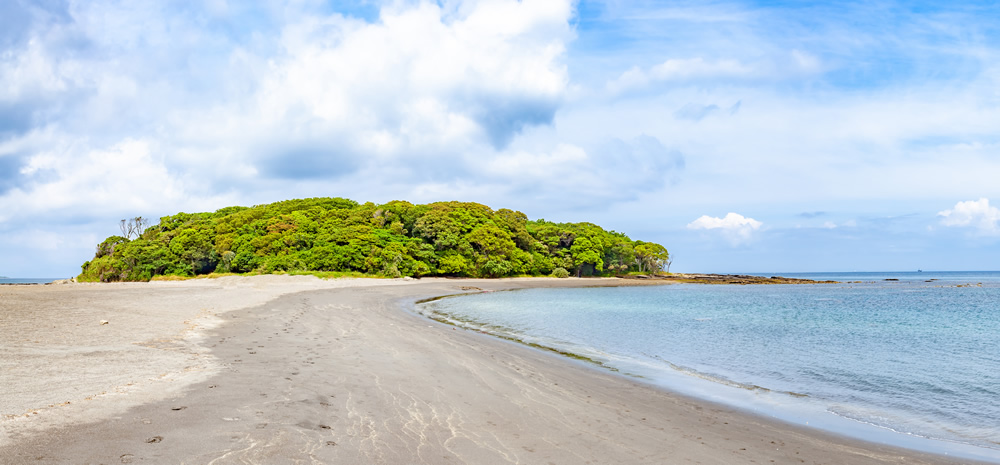
Okinoshima is an isolated island with a circumference of approximately 4 kilometers located roughly in the center of the Genkai Sea, approximately 60 kilometers offshore from Munakata City, Fukuoka Prefecture. The entire island serves as the sanctuary of Munakata Taisha, and the Okitsu Shrine enshrines Tagori-hime-no-kami, one of the three female deities of Munakata.
Ancient Rituals on Okinoshima
From the late 4th century to the end of the 9th century, rituals were conducted on Okinoshima on a national scale to pray for maritime safety and the success of external relations. The form of ritual changed over time and is classified into the following four stages:
First Stage (Late 4th to 5th Century): The era of rock-surface rituals. Rituals were performed on large boulders, and bronze mirrors, beads, weapons, and other items were offered.
Second Stage (Late 5th to Early 7th Century): The era of rock-shelter rituals. Rituals were performed under boulders or in rock shelters, and luxurious items such as gilded bronze horse trappings, ornaments, weapons, and glass products indicating exchange with the Korean Peninsula and the Chinese mainland were offered.
Third Stage (Late 7th to Early 8th Century): The semi-rock-shelter and semi-open-air ritual era. Votive offerings included gilded bronze Buddhist implements, bronze mirrors, and gold rings, with Buddhist elements being incorporated.
Fourth Stage (8th to End of 9th Century): The open-air ritual era. The location of rituals moved to open-air settings, and votive offerings changed to bronze mirrors, iron axes, and steatite figurines.
The Tradition of “Oiwazu-sama”
Strict prohibitions have long been observed on Okinoshima. This prohibition, called “Fugen-sama (Oiwazu-sama),” is a rule that one must not speak of what one sees or hears on the island. Additionally, a tradition of women’s exclusion has been maintained, and public access remains strictly restricted even today. Shinto priests from Munakata Taisha are stationed on the island in rotation, performing daily rituals.
2. Munakata Taisha Okitsu Shrine Distant Worship Spot
Since public landing on Okinoshima is prohibited, a distant worship spot for the Okitsu Shrine has been established at the northern end of Okinoshima (Oshima). From here, one can reverently view Okinoshima, which is approximately 48 kilometers away. On clear days, the shape of Okinoshima can be confirmed on the horizon.
3. Munakata Taisha Naka Shrine (Oshima)
Oshima is an island with a circumference of approximately 15 kilometers located approximately 11 kilometers offshore from Munakata City, where approximately 700 people reside. In the central part of the island stands the Naka Shrine enshrining Tagitsu-hime-no-kami, one of the three female deities of Munakata.
The founding period of Naka Shrine is unclear; however, archaeological investigation has revealed that from the late 7th century onward, rituals similar to those on Okinoshima were conducted. The current shrine buildings were reconstructed during the Edo period, with the main hall, worship hall, and gate tower beautifully painted in vermillion red.
4. Munakata Taisha Naka Shrine Precincts Archaeological Site
Archaeological remains of rituals from the late 7th to 10th centuries have been discovered within the precincts of Naka Shrine. Excavated artifacts include steatite figurines, pottery, and bronze mirrors, sharing characteristics common to the rituals on Okinoshima. These archaeological remains serve as important evidence that the rituals on Okinoshima expanded to Oshima as well.
5. Munakata Taisha Hentsu Shrine
The Hentsu Shrine, located in Tajima, Munakata City, is the main shrine building enshrining Ichikishima-hime-no-kami, one of the three female deities of Munakata. It has served as the central shrine among the three shrines of Munakata.
The founding of Hentsu Shrine dates back to antiquity, with records appearing in the Nihon Shoki. The current main hall was reconstructed in 1578 and is designated as an Important Cultural Property of Japan. The precincts include a worship hall, prayer hall, and sacred treasure hall, attracting many worshippers throughout the year.
Sacred Treasure Hall
The Sacred Treasure Hall located within the precincts of Hentsu Shrine displays a selection of approximately 80,000 National Treasure items excavated from Okinoshima. One can view up close precious cultural assets including ancient gold rings, gilded bronze dragon heads, and triangular-rimmed spirit beasts mirrors, which speak to East Asian international exchange.
6. Munakata Taisha Hentsu Shrine Precincts Archaeological Site
Archaeological remains of rituals from the late 7th to 10th centuries have also been discovered within the precincts of Hentsu Shrine. Excavated artifacts include steatite figurines, pottery, and iron products, demonstrating that rituals similar to those on Okinoshima and Oshima were also conducted on the Kyushu mainland.
7. Niihar Nukiyama Kofun Cluster
The Niihar Nukiyama Kofun Cluster in Fukutsu City consists of 41 ancient tumuli constructed from the 5th to 6th centuries. These tumuli are believed to be the burial grounds of the Munakata clan, the powerful local chieftains who ruled the Munakata region.
The cluster includes 5 keyhole-shaped tumuli, 35 circular tumuli, and 1 rectangular tumuli. Their scale and number attest to the powerful influence the Munakata clan held in ancient times. It is surmised that the Munakata clan was entrusted by the Yamato court with performing rituals to pray for maritime safety and, in return, gained considerable power.
8. Tsuyazaki Kofun Cluster (Miyaji-take Kofun)
The Tsuyazaki Kofun Cluster in Fukutsu City, located behind Miyaji-take Shrine, consists of tumuli constructed from the late 6th to early 7th century. The central Miyaji-take Kofun is a large circular tumulus with a 23-meter-long horizontal stone chamber, known as one of Kyushu’s largest stone chambers from the late tumulus period.
Luxury grave goods including gilded bronze horse trappings, ornaments, and weapons were excavated from the stone chamber, with over 300 items designated as National Treasures. These ancient tumuli serve as physical evidence of the prosperity of the Munakata clan and the importance of the Munakata region in antiquity.
History of Faith in the Three Female Deities of Munakata
Faith in the three female deities of Munakata originates in Japanese ancient mythology. According to the Kojiki and Nihon Shoki, the three goddesses of Munakata were born from a pledge (ukehi) between Amaterasu Ōmikami and Susanoo, and by divine decree of Amaterasu Ōmikami, they descended to the Munakata region.
Roles of the Three Deities
The three female deities of Munakata, though enshrined in different locations, have been venerated as one entity, serving as guardian deities of maritime transport and deities ensuring safe voyages:
- Tagori-hime-no-kami: Enshrined at Okitsu Shrine on Okinoshima
- Tagitsu-hime-no-kami: Enshrined at Naka Shrine on Oshima
- Ichikishima-hime-no-kami: Enshrined at Hentsu Shrine on the mainland
These three shrines are collectively referred to as “Munakata Taisha” and have remained objects of faith from ancient to modern times.
Transmission and Development of Faith
With the establishment of the Ritsuryo state in the late 7th century, faith in the three female deities of Munakata developed to a national scale. The imperial court designated Munakata Taisha as an “official shrine,” and whenever envoys to Tang Dynasty China or Silla were dispatched, rituals were always performed to pray for maritime safety.
During the Heian period, Munakata Taisha was granted the highest rank of “Meishin Taisha” (Shrine of Renowned Deities) and is recorded in the Engishiki Jinmeicho. From the medieval period onward, the Munakata clan continued to serve as chief priests, perpetuating rituals that continued to attract the faith of vessels navigating the Genkai Sea, a crucial crossroads of maritime traffic.
In the early modern period, Kuroda Yoshitaka, the daimyo of Chikuzen Fukuoka Domain, deeply revered Munakata Taisha and supported the construction and repair of its shrine buildings. In modern times, the faith of those involved with the sea—including the Japan Maritime Self-Defense Force, shipping companies, and fishing-related personnel—remains strong, with many worshippers visiting throughout the year.
Circumstances Leading to World Heritage Registration
The path to World Heritage registration for “Island of the Gods” Munakata and Okinoshima and Related Heritage Sites is the crystallization of long-term regional efforts.
Major Circumstances Leading to Registration
January 2009: “Munakata and Okinoshima and Related Heritage Sites” was added to the UNESCO Tentative List. The initial constituent asset proposal included, in addition to the eight assets, the mountaintop archaeological site of Konomi-yama, a subsidiary shrine of Munakata Taisha.
July 2015: The Agency for Cultural Affairs selected “Island of the Gods” Munakata and Okinoshima and Related Heritage Sites as a candidate for 2017 World Heritage registration.
January 2016: The Japanese government submitted a formal nomination to UNESCO.
May 2017: ICOMOS (International Council on Monuments and Sites), an advisory body to UNESCO, recommended registration of only four assets including Okinoshima. This recommendation proposed excluding the Niihar Nukiyama Kofun Cluster, Tsuyazaki Kofun Cluster, Hentsu Shrine, and Naka Shrine.
July 2017: At the 41st World Heritage Committee meeting, following tenacious negotiations by the Japanese government and local authorities, all eight assets were decided to be registered as a “batch registration.”
Reversal from ICOMOS Recommendation
ICOMOS initially recommended registration of only four assets because it determined that the kofun clusters and mainland shrines had tenuous direct connections to faith on Okinoshima. However, the Japanese side emphasized the following points to advocate for batch registration of all assets:
- The historical continuity of rituals on Okinoshima expanding to Oshima and the mainland
- The Munakata clan’s stewardship of rituals from the tumulus period, with their power base demonstrated in the kofun clusters
- The three shrines forming a unity to constitute faith in the three female deities of Munakata, which has been transmitted to the present
These arguments were accepted, resulting in the historic outcome of all eight assets being registered as World Heritage.
Registration Criteria and Outstanding Universal Value
“Island of the Gods” Munakata and Okinoshima and Related Heritage Sites was registered as meeting the following two of the World Heritage registration criteria.
Criterion (ii): Interchange of Values
“During the period of active exchange in East Asia from the 4th to 9th centuries, the tradition of rituals on Okinoshima developed and prompted the development of related ritual archaeological remains on Oshima and the Kyushu mainland. These archaeological remains demonstrate the transition of ancient rituals and provide outstanding evidence of the development of faith in this region.”
This criterion evaluates how cultural exchange in ancient East Asia significantly influenced the development of rituals in the Munakata region, crystallizing into distinctive forms of faith. The votive offerings excavated from Okinoshima include many items originating from the Korean Peninsula and the Chinese mainland, serving as precious physical evidence of international exchange during that period.
Criterion (iii): Evidence of Cultural Tradition
“The ritual archaeological remains on Okinoshima, the related sites on Oshima and the Kyushu mainland, and the three shrine buildings of Munakata Taisha constitute rare physical evidence that a tradition of faith originating in ancient nature worship has been transmitted to the present day as a living form.”
This criterion evaluates the continuity of faith in the three female deities of Munakata, which has been transmitted for approximately 1,700 years since the 4th century, and that this faith functions as a living tradition in modern times. In particular, the continuation of strict prohibitions observed on Okinoshima and the ongoing rituals conducted throughout the year represent an extremely rare example globally.
Integrity and Authenticity
In UNESCO World Heritage registration, the requirements of “integrity” and “authenticity” must be met to demonstrate outstanding universal value.
Integrity: The eight constituent assets all contain the elements necessary to completely express the series of narrative from the development of ancient rituals on Okinoshima to their expansion to Oshima and the mainland and the inheritance of faith continuing to the present day.
Authenticity: The ritual archaeological remains on Okinoshima are preserved in an almost untouched state, maintaining high authenticity in form and design. Additionally, the rituals conducted at the three shrines of Munakata Taisha inherit traditions from antiquity, with authenticity recognized in function and tradition.
Preservation and Management Initiatives
To transmit the value as a World Heritage Site to future generations, Fukuoka Prefecture, Munakata City, Fukutsu City, and Munakata Taisha cooperate in implementing comprehensive preservation management plans.
Legal Protection Measures
Many of the constituent assets receive the following designations under the Cultural Properties Protection Law:
- National Treasures: Approximately 80,000 items excavated from Okinoshima
- Historic Sites: Okinoshima, Naka Shrine Precincts Archaeological Site, Hentsu Shrine Precincts Archaeological Site, Niihar Nukiyama Kofun Cluster, Tsuyazaki Kofun Cluster
- Important Cultural Properties: Hentsu Shrine Main Hall and others
These designations require permission from the Director-General of the Agency for Cultural Affairs for any changes to their current state, ensuring strict protection.
Protection of Okinoshima
Okinoshima, with its entire island serving as the sanctuary of Munakata Taisha, is strictly protected under Munakata Taisha’s administration. Public landing is in principle prohibited, with access permitted only once annually on May 27, when the Grand Festival is held, limited to approximately 200 male worshippers.
Additionally, the waters surrounding Okinoshima have been designated as a protection zone, with fishing activities restricted. This ensures that the island’s natural environment and ritual archaeological remains are protected as an integrated whole.
Monitoring System
To continuously monitor the preservation status of the World Heritage Site, the “Preservation and Utilization Council for World Heritage ‘Island of the Gods’ Munakata and Okinoshima and Related Heritage Sites” has been established. This council, consisting of Fukuoka Prefecture, Munakata City, Fukutsu City, Munakata Taisha, and experts, regularly conducts checks and evaluations of preservation status.
Post-Registration Developments and Issues
Following World Heritage registration, “Island of the Gods” Munakata and Okinoshima and Related Heritage Sites has received significant attention from both domestic and international audiences.
Increase in Tourist Numbers
Following World Heritage registration, the number of tourists to Munakata Taisha Hentsu Shrine and Oshima has increased significantly. Shortly after the 2017 registration, the number of worshippers at Hentsu Shrine increased approximately 30% compared to the previous year, with noticeable growth in ferry users to Oshima.
While this increase in tourism has had positive effects on the regional economy, it has also created the following challenges:
- Coping with Congestion: Concentration of worshippers on weekends and holidays in particular
- Parking Shortage: Chronic insufficiency of parking spaces around Hentsu Shrine
- Environmental Impact: Strain on the natural environment accompanying increased tourism on Oshima
To address these challenges, local authorities have implemented measures including expanding parking facilities, operating shuttle buses, and dispersing tourist flows.
Information Dissemination and Guidance Facilities
To ensure proper understanding of the World Heritage’s value, multiple guidance facilities have been established.
Umi no Michi Munakata Museum (Munakata City)
“Umi no Michi Munakata Museum,” adjacent to the Munakata Road Station, opened in April 2018 as a comprehensive guidance facility for the World Heritage. The museum provides the history of rituals on Okinoshima, displays of replicas of excavated items, and video explanations, allowing visitors to understand the overall scope of the World Heritage.
Oshima Exchange Center (Munakata City, Oshima)
Near the port on Oshima, the Oshima Exchange Center features exhibits on the history and culture of Oshima and information about Naka Shrine. It also provides access information to the Okitsu Shrine distant worship spot and tourism guidance for the island.
Tsuyazaki Sennin Nagomi (Fukutsu City)
In the Tsuyazaki district of Fukutsu City, “Tsuyazaki Sennin Nagomi” features exhibits on the Niihar Nukiyama Kofun Cluster and Tsuyazaki Kofun Cluster, with rich information on the history of the Munakata clan during the tumulus period and introductions of excavated artifacts.
Construction of Digital Archives
Fukuoka Prefecture has established an official digital archive website (www.munakata-archives.asia) to widely disseminate the World Heritage’s value. The site provides detailed information on the constituent assets, high-definition images, 3D models, research papers, and other materials accessible worldwide.
Particularly for Okinoshima, where public landing is prohibited, aerial drone footage and 360-degree panoramic images have been released, allowing virtual experience of the island.
Access and Tourism Information
Practical information for visiting the World Heritage “Island of the Gods” Munakata and Okinoshima and Related Heritage Sites is provided below.
Access to Munakata Taisha Hentsu Shrine
By Train:
- From “Togo Station” on the JR Kagoshima Main Line, take a bus heading to Kaninnomoto Wharf for approximately 12 minutes, get off at “Munakata Taisha-mae”
- From Nishi-Tetsu Bus “Tenjin,” take a bus heading to “Kaninnomoto Wharf” for approximately 60 minutes, get off at “Munakata Taisha-mae”
By Car:
- Approximately 20 minutes from “Wakamiya IC” on the Kyushu Expressway
- Approximately 25 minutes from “Koga IC”
- Parking: First Parking Lot (Free, approximately 100 spaces), Second Parking Lot (Free, approximately 100 spaces)
Opening Hours:
- 6:00 to 17:00 (varies by season)
- Sacred Treasure Hall: 9:00 to 16:30 (last entry 16:00), closed Tuesdays (if Tuesday is a holiday, closed the following day)
Access to Oshima (Naka Shrine)
Oshima is accessed by ferry or passenger ship from Kaninnomoto Port.
Ferry:
- Travel time: Approximately 25 minutes
- Fare: Adult one-way 560 yen, round-trip 1,060 yen
- Service: 7-8 departures daily (varies by season)
- Vehicle transport available (advance reservation required)
Passenger Ship:
- Travel time: Approximately 15 minutes
- Fare: Adult one-way 650 yen, round-trip 1,230 yen
- Service: 3-4 departures daily
On Oshima, rental bicycles and rental cars are convenient options. For visiting Naka Shrine and the Okitsu Shrine distant worship spot, approximately half a day on foot or 2-3 hours by bicycle is a general estimate.
Access to Niihar Nukiyama Kofun Cluster
By Train:
- From “Fukuma Station” on the JR Kagoshima Main Line, take a Nishi-Tetsu bus heading to “Tsuyazaki-bashi” for approximately 15 minutes, get off at “Hanamigagahama,” approximately 5 minutes on foot
By Car:
- Approximately 25 minutes from “Koga IC” on the Kyushu Expressway
- Parking: Available (Free)
Walking trails have been developed within the kofun cluster, allowing free observation. The visitor center displays explanatory panels of the kofun cluster and replicas of excavated items.
Access to Tsuyazaki Kofun Cluster (Miyaji-take Kofun)
Miyaji-take Kofun is located within the precincts of Miyaji-take Shrine.
By Train:
- From “Fukuma Station” on the JR Kagoshima Main Line, take a Nishi-Tetsu bus heading to “Tsuyazaki-bashi” for approximately 5 minutes, get off at “Miyaji-take Shrine-mae”
By Car:
- Approximately 20 minutes from “Koga IC” on the Kyushu Expressway
- Parking: Available (Free, approximately 500 spaces)
By ascending the rear shrine path of Miyaji-take Shrine, the stone chamber of the kofun can be observed (check public access dates and times).
Frequently Asked Questions (FAQ)
Is it possible to land on Okinoshima?
Public landing on Okinoshima is in principle prohibited. Once annually, on May 27 during the Grand Festival, approximately 200 male worshippers selected by lottery are permitted to land. Women’s landing is not permitted due to traditional prohibitions. To view Okinoshima, one can reverently view it from the Okitsu Shrine distant worship spot on Oshima.
How much time is needed to visit all World Heritage Sites?
At minimum, 2 days are required to visit all eight constituent assets. A typical plan involves visiting Munakata Taisha Hentsu Shrine and the Niihar Nukiyama and Tsuyazaki Kofun Clusters on the first day, and traveling to Oshima on the second day to visit Naka Shrine and the Okitsu Shrine distant worship spot. If you wish to spend more time at each location, we recommend allowing approximately 3 days.
When are rituals and events held at Munakata Taisha?
Various rituals and events are held at Munakata Taisha throughout the year. Major annual events include:
- January 1-3: New Year’s Grand Festival
- February 11: Foundation Day Festival
- May 27: Okitsu Shrine On-Site Grand Festival
- October 1-3: Autumn Grand Festival (Miae Festival)
- December 31: Great Purification Ceremony, New Year’s Eve Festival
In particular, the Autumn Grand Festival in October is the most spectacular, with the “Miae Festival” marine procession welcoming the kami from Okinoshima to Oshima and the mainland being a sight to behold. The spectacle of approximately 200 fishing boats advancing across the Genkai Sea is breathtaking and draws many tourists.
What kinds of exhibits are displayed at the Sacred Treasure Hall?
The Sacred Treasure Hall within the precincts of Munakata Taisha Hentsu Shrine displays approximately 600 pieces from approximately 80,000 National Treasure items excavated from Okinoshima on a regular basis. Principal exhibits include:
- Gold rings (5th century)
- Gilded bronze dragon heads (6th century)
- Triangular-rimmed spirit beasts mirrors (4th century)
- Glass comma-shaped beads
- Gilded bronze horse trappings
- Steatite figurines
Exhibits are arranged chronologically, providing an easily understandable structure for comprehending the transition of ancient rituals. Special exhibitions are also held periodically.
Is overnight accommodation possible on Oshima?
Oshima has several minshuku (family-run inns) and traditional inns where overnight accommodation is available. Staying overnight on the island provides an opportunity to slowly experience the island’s nature and culture. Fresh seafood cuisine is also an attractive feature. However, as the number of accommodations is limited, advance reservations are essential, particularly on weekends, holidays, and during tourist season.
What has changed due to World Heritage registration?
World Heritage registration has significantly increased international recognition of “Island of the Gods” Munakata and Okinoshima and Related Heritage Sites. Accompanying this, the number of domestic and international tourists has increased, contributing to regional economic revitalization. Meanwhile, balancing heritage protection and utilization has become an important issue, with the entire region working to promote sustainable tourism, implement appropriate preservation management, and transmit the heritage to future generations.
Conclusion: Transmitting “Island of the Gods” to the Future
“Island of the Gods” Munakata and Okinoshima and Related Heritage Sites is a precious World Heritage Site that speaks to faith in the three female deities of Munakata and the endeavors of the people who have sustained this faith, transmitted for approximately 1,700 years from ancient to modern times.
The ancient ritual archaeological remains on Okinoshima, serving as the “Shosoin of the Sea,” possess extremely important archaeological value in demonstrating the reality of East Asian international exchange from the 4th to 9th centuries. Additionally, the tradition of viewing the entire island as sacred, observing strict prohibitions, transmits to the present day the prototype of Japanese faith culture based on nature worship.
Naka Shrine on Oshima, Hentsu Shrine on the mainland, and the kofun clusters as the burial grounds of the Munakata clan demonstrate the process by which rituals on Okinoshima expanded to Oshima and the mainland and developed as faith rooted in regional society. These constituent assets united together express a culturally traditional faith transmission from ancient to modern times, a rare phenomenon globally.
World Heritage registration signifies that international society recognized this precious cultural heritage as a human heritage to be shared. Simultaneously, responsibility arises to appropriately protect it and transmit it to future generations.
Fukuoka Prefecture, Munakata City, Fukutsu City, and Munakata Taisha, cooperating with regional residents and experts, are engaged in the preservation and utilization of the World Heritage. Balancing tourism promotion with heritage protection and continuing to disseminate the World Heritage’s value in a sustainable manner will be important issues going forward.
Visiting “Island of the Gods” Okinoshima and Munakata provides a valuable opportunity to touch a faith tradition continuing from antiquity and rediscover the cultural roots of Japan. We hope you will experience this World Heritage Site while contemplating the ritual tradition preserved across the rough waves of the Genkai Sea, the faith flourishing on the islands, and the thoughts of the people who have transmitted this heritage to the present day.