Jomon Ruins of Hokkaido and Northeast Honshu: Complete Guide to Aomori Prefecture’s World Heritage Site
On July 27, 2021, the “Jomon Ruins of Hokkaido and Northeast Honshu” were officially registered as a UNESCO World Cultural Heritage Site. This registration recognized it as a rare cultural heritage in human history, conveying the life and spiritual culture of people during the Jomon period, who maintained a sedentary society before agriculture for over 10,000 years. This article provides a detailed explanation of the entire scope of this world heritage site, focusing in particular on the component assets of Aomori Prefecture.
The Jomon Ruins of Hokkaido and Northeast Honshu
The Jomon Ruins of Hokkaido and Northeast Honshu comprise 17 archaeological sites spread across Hokkaido and three northeastern prefectures (Aomori, Iwate, and Akita). These sites belong to a unified cultural sphere on either side of the Tsugaru Strait and demonstrate the process of the beginning, development, and maturation of sedentary settlement from approximately 15,000 to 2,400 years ago during the Jomon period.
Universal Value as a World Heritage Site
The outstanding universal value of this ruins group lies in its demonstration of evidence that a sedentary society not based on agriculture developed sustainably over an extended period. In many parts of the world, the initiation of agriculture was essential for the formation of sedentary societies; however, the Jomon people realized over 10,000 years of sedentary life through gathering, fishing, and hunting that utilized the abundant gifts of nature.
This unique social form serves as a model of an environmentally harmonious and sustainable lifestyle, offering important implications for contemporary society.
The Path to World Heritage Registration
Preparatory Period Before Nomination
Formal efforts toward world heritage registration of the Jomon Ruins of Hokkaido and Northeast Honshu began in earnest in the early 2000s. The four prefectures, centered on Aomori, had the “Jomon Ruins Group centered on Hokkaido and Northeast Honshu” inscribed on the UNESCO Tentative List in 2009.
Initially, there were more component asset candidates than currently exist. The nomination document creation process involved repeated refinement. Through consultations with the Agency for Cultural Affairs and experts, sites that could most effectively demonstrate value as a world heritage site were selected.
Submission and Review of the Nomination Document
In 2020, the Japanese government formally submitted the nomination document to UNESCO. In May 2021, ICOMOS, UNESCO’s advisory body, recommended “inscription.” Following this recommendation, it was formally registered as a World Cultural Heritage Site at the 44th World Heritage Committee Plenary Session held on July 27 of that year.
Assets Removed from Consideration Before Nomination
During the nomination document creation process, several sites were removed from consideration. This did not mean their value was low, but rather reflected the judgment that 17 component assets could most effectively explain the development process of Jomon sedentary society. The removed sites maintain their important positioning as related assets.
Registration Criteria and Evaluation
The Jomon Ruins of Hokkaido and Northeast Honshu were evaluated as meeting the following criteria for world heritage registration:
Registration Criterion (iii)
“To bear a unique (or at least rare) testimony to a cultural tradition or to a civilization which is living, or which has disappeared”
Under this criterion, the Jomon ruins group was recognized as a rare example of a pre-agricultural sedentary society that continued for over 10,000 years. From a global perspective, evidence of hunter-gatherer societies sustained for such extended periods is extremely limited.
Registration Criterion (v)
“To be an outstanding example of a traditional human settlement, land-use, or sea-use which is representative of a culture (or cultures), or human interaction with the environment especially when it has become vulnerable under the impact of irreversible change”
Under this criterion, the point was evaluated that the Jomon people maintained a sustainable lifestyle in harmony with nature while adapting to environmental changes. The wisdom shown in flexibly responding to environmental changes such as climate fluctuations and sea-level changes, and utilizing resources without depleting them, was recognized.
List of Component Assets and Six Stages
The 17 component assets are classified into six stages demonstrating the process of the beginning, development, and maturation of settlement during the Jomon period.
Stage 1: Beginning of Settlement (approximately 15,000 to 11,000 years ago)
Hokkaido
- Ohdaira Motomachi Ruins (Hakodate City)
Aomori Prefecture
- Ohdaira Motomachi Ruins (Sotogahama Town)
In this stage, as the ice age ended and warming progressed, traces of people beginning to settle are visible. Some of the world’s oldest pottery has been excavated, indicating the emergence of sedentary life.
Stage 2: Development of Settlement (approximately 7,000 to 5,000 years ago)
Hokkaido
- Kakino Island Ruins (Hakodate City)
- Kitakogane Shell Midden (Date City)
Aomori Prefecture
- Tashoryano Shell Midden (Tsugaru City)
- Futatsumori Shell Midden (Shichinohe Town)
In this stage, shell midden formation began and the use of marine resources became full-fledged. The formation of burial grounds is also visible, and the development of spiritual culture can be confirmed.
Stage 3a: Maturation of Settlement (Appearance of Base Settlements) (approximately 5,000 to 4,000 years ago)
Aomori Prefecture
- Sanai Maruyama Ruins (Aomori City)
- Komakino Ruins (Aomori City)
Akita Prefecture
- Oyu Circular Earthen Embankment (Kazuno City)
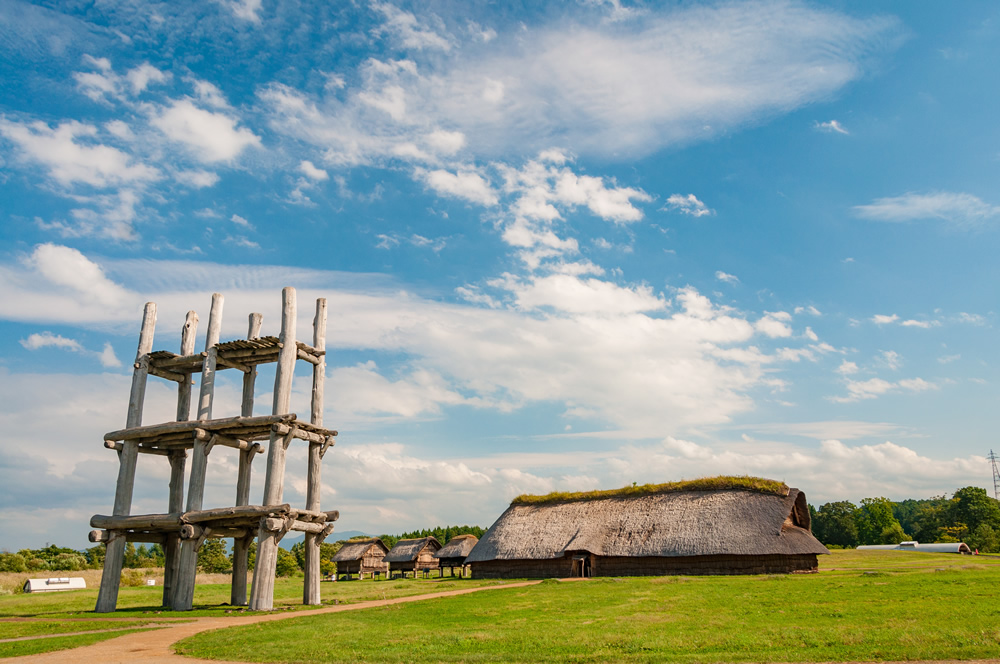
The Sanai Maruyama Ruins represent the largest base settlement among the Jomon ruins group. A highly organized settlement structure is confirmed, including large post-hole buildings, pit dwellings, burial grounds, and roads. During this period, the population increased and settlement scale expanded.
Stage 3b: Maturation of Settlement (Appearance of Circular Stone Arrangements) (approximately 4,000 to 3,000 years ago)
Hokkaido
- Kius Shūtei Burial Mound Group (Chitose City)
- Irie Shell Midden (Toya Town)
- Takasago Shell Midden (Toya Town)
Aomori Prefecture
- Omori Katsuyama Ruins (Hirosaki City)
- Korekawa Stone Age Ruins (Hachinohe City)
Iwate Prefecture
- Goshono Ruins (Ichinohe Town)
Akita Prefecture
- Isedodai Ruins (Kitaakita City)
In this stage, large-scale structures related to ritual and ceremony, such as circular stone arrangements (stone circles) and peripheral burial mounds, were constructed. Maturation of spiritual culture and strengthening of social cohesion are evident.
Eight Component Assets of Aomori Prefecture Explained in Detail
Aomori Prefecture possesses 8 of the 17 component assets, serving as the core of the Jomon ruins group.
Sanai Maruyama Ruins (Aomori City)
The Sanai Maruyama Ruins are a large-scale settlement site from the early-to-middle Jomon period (approximately 5,900 to 4,200 years ago). It was continuously occupied for approximately 1,700 years, with estimates suggesting hundreds of people lived there during its peak.
Main Features:
- Large post-hole building: remains of a six-post structure using chestnut wood approximately one meter in diameter
- Pit dwellings: over 800 identified
- Earthen mound: large-scale earthen mound related to ritual and disposal
- Burial ground: numerous pit graves including children’s graves
- Road: planned road network connecting the settlement
- Storage pits: pits for food storage
Abundant artifacts have been excavated, including pottery, stone tools, clay figurines, and jade ornaments. Notably, the excavation of jade from Itoigawa in Niigata Prefecture and obsidian from Hokkaido proves the existence of wide-ranging exchange and trade networks.
Komakino Ruins (Aomori City)
The Komakino Ruins are a site centering on circular stone arrangements constructed during the early-to-late Jomon period (approximately 4,000 years ago). Located at approximately 145 meters elevation on a hill, it functioned as a ritual and ceremonial site.
Main Features:
- Double circular stone arrangement: a structure approximately 55 meters in diameter consisting of outer and inner rings
- Precise stone placement: approximately 2,500 stones arranged systematically
- Triangular-shaped stone piles: characteristic stone arrangements in the central portion of the circular arrangement
- Vista: overlooking Mutsu Bay and the Shimokita Peninsula
The circular stone arrangements at Komakino may be related to astronomical observation or seasonal rituals.
Ohdaira Motomachi Ruins (Sotogahama Town)
The Ohdaira Motomachi Ruins are from the Jomon incipient period (approximately 16,500 to 15,000 years ago), with some of the world’s oldest pottery fragments excavated here. This discovery provides important evidence showing the close relationship between pottery invention and the beginning of settlement.
Main Features:
- Undecorated pottery: oldest-class pottery without ornamentation
- Stone tools: stone arrowheads, stone spears, and other hunting implements
- Hearth remains: traces of sedentary life
Futatsumori Shell Midden (Shichinohe Town)
The Futatsumori Shell Midden is a shell midden site from the early-to-middle Jomon period (approximately 5,500 to 4,500 years ago). Despite being located inland, the abundant excavation of marine products indicates active exchange with coastal areas.
Main Features:
- Shell layer: primarily freshwater shells, particularly Yamato clams
- Animal remains: terrestrial animals such as deer and wild boar
- Fish bones: marine fish such as sea bream and sharks
- Pottery and stone tools: abundant household implements
Tashoryano Shell Midden (Tsugaru City)
The Tashoryano Shell Midden is a shell midden site from the early-to-middle Jomon period (approximately 5,500 to 4,000 years ago). Located in lowlands near Lake Jūsan, it clarifies the lifestyle utilizing brackish water resources.
Main Features:
- Clam shell layer: large-scale deposits of Yamato clams
- Burial ground: numerous human remains in flexed position
- Clay figurines: artifacts indicating spiritual culture
- Bone and antler tools: fishing implements such as fishhooks and harpoons
Omori Katsuyama Ruins (Hirosaki City)
The Omori Katsuyama Ruins are a site centering on circular stone arrangements from the late Jomon period (approximately 3,000 years ago). Located at approximately 250 meters elevation on a hill at the foot of Mount Iwaki, it is characterized by deliberate orientation toward Mount Iwaki.
Main Features:
- Circular stone arrangement: elliptical structure approximately 48 meters long and 36 meters wide
- Relationship with Mount Iwaki: deliberately positioned with a view of Mount Iwaki
- Stone arrangement burial: burial facilities within the arrangement
- Pottery and stone tools: characteristic late-period artifacts
The Omori Katsuyama Ruins suggest connections to nature worship and mountain worship, making it important for understanding the spiritual world of the Jomon people.
Korekawa Stone Age Ruins (Hachinohe City)
The Korekawa Stone Age Ruins are a group of sites from the middle-to-late Jomon period (approximately 5,500 to 2,300 years ago), comprising three sites: Nakai Ruins, Ichiooji Ruins, and Tsutsuida Ruins.
Main Features:
- Lacquered items: red-lacquered pottery, combs, bracelets, and other elaborate lacquerware
- Wooden items: well-preserved wooden implements such as bows and containers
- Bone and antler tools: diverse implements including fishhooks and harpoons
- Clay figurines: finely crafted figurines
The excavation of lacquered items particularly demonstrates the advanced technology and aesthetic sensibility of the Jomon period. The Korekawa Jomon Museum allows viewing of these valuable excavated items.
Kamegaoka Stone Age Ruins (Tsugaru City)
The Kamegaoka Stone Age Ruins are from the late Jomon period (approximately 3,000 to 2,300 years ago) and are known for elaborate pottery and clay figurines. Particularly, the “Dogū with Goggles” is famous as a representative artifact of Jomon culture.
Main Features:
- Dogū with Goggles: large clay figurine with eye expression resembling snow goggles
- Kamegaoka-style pottery: pottery with elaborate patterns and thin-walled vessels
- Lacquered items: advanced lacquerware technology
- Ornaments: diverse decorative items such as ear ornaments and bracelets
Kamegaoka culture spread from the Tōhoku region to southern Hokkaido, representing the pinnacle of late Jomon culture.
Component Assets of Hokkaido, Iwate Prefecture, and Akita Prefecture
Six Sites in Hokkaido
Hokkaido has six component assets, all concentrated in the southern Hokkaido region.
- Ohdaira Motomachi Ruins (Hakodate City): Jomon incipient period site
- Kakino Island Ruins (Hakodate City): site with clearly distinct burial ground and settlement
- Kitakogane Shell Midden (Date City): site with shell midden and burial ground
- Kius Shūtei Burial Mound Group (Chitose City): burial ground consisting of nine peripheral burial mounds
- Irie Shell Midden (Toya Town): site with shell midden and circular stone arrangement
- Takasago Shell Midden (Toya Town): site integrated with Irie Shell Midden
One Site in Iwate Prefecture
Goshono Ruins (Ichinohe Town) is a large-scale settlement site from the late-middle Jomon period (approximately 4,500 to 4,000 years ago). The reconstruction of soil-roofed dwellings and stone arrangement structures provide well-preserved views of the entire settlement.
Two Sites in Akita Prefecture
- Oyu Circular Earthen Embankment (Kazuno City): two large circular stone arrangements—Manza and Nonakadō
- Isedodai Ruins (Kitaakita City): ritual site with four circular stone arrangements
Related Assets and Guidance Facilities
Related Assets
Beyond the component assets, there are related assets that deepen understanding of the Jomon ruins group.
- Washinoki Ruins (Mori Town, Hokkaido): site with circular stone arrangement
- Chōshichiyaji Shell Midden (Hachinohe City, Aomori): shell midden related to Korekawa Ruins
These are positioned as important archaeological sites that complement the component assets.
Guidance Facilities
Guidance facilities have been developed at each component asset to deepen understanding of the site.
Major Guidance Facilities in Aomori Prefecture:
- Sanai Maruyama Ruins Center (Aomori City)
- Jomon Learning House/Komakino Hall (Aomori City)
- Korekawa Jomon Museum (Hachinohe City)
- Tsugaru City Jomon Dwelling Exhibition Museum Karuko (Tsugaru City)
- Kitaakita City Jomon Museum (Kitaakita City)
These facilities allow visitors to learn about Jomon culture through artifact exhibitions, video materials, and experiential programs.
Life and Spiritual Culture During the Jomon Period
Sedentary Life Based on Gathering, Fishing, and Hunting
The Jomon people lived without agriculture, utilizing the gifts of nature.
Gathering:
- Plant-based food: nuts such as chestnuts, walnuts, acorns, and horse chestnuts
- Edible plants: warabi, zenmai, butterbur, and other wild vegetables
- Fruits: wild grapes, raspberries, and other berries
Fishing:
- Marine fish: sea bream, sharks, tuna, bonito, and other species
- Shellfish: hard-shell clams, Manila clams, oysters, Yamato clams, and others
- Marine mammals: seals, dolphins, and other animals
Hunting:
- Large mammals: deer, wild boar, bears, and others
- Birds: ducks, pheasants, and other species
The Jomon people systematically utilized different resources according to the season, ensuring stable food supplies year-round. In particular, managed cultivation of chestnuts was an important factor that enabled settlement without the transition to agriculture.
Spiritual Culture and Ritual
A rich spiritual culture developed during the Jomon period.
Clay Figurines (Dogū):
Ceramic figurines modeled after women, believed to have been used in rituals praying for safe childbirth and bountiful harvests. Many types of clay figurines were produced, including the famous Dogū with Goggles.
Circular Stone Arrangements (Stone Circles):
Ritual facilities with stones arranged in circles, functioning as sites for ceremonies that strengthened community cohesion. Connections to astronomical observation and seasonal festivals are also suggested.
Burial Practices:
Various burial methods are evident, including flexed burials and extended burials. Many graves include grave goods, suggesting beliefs about the afterlife and the existence of social status.
Ornaments:
Earrings, bracelets, necklaces, and other items were made from jade, amber, shells, and other materials. These expressed both social status or roles and aesthetic sensibilities.
Conservation and Utilization of the Jomon Ruins Group
Conservation Management Plan
Following world heritage registration, the four prefectures have collaborated in conservation efforts for the Jomon ruins group. At each site, continuous efforts include structure protection, environmental improvement, and monitoring surveys.
Utilization and Tourism
The Jomon ruins group serves as an important cultural tourism resource. Guided tours, experiential programs, and events are held in various locations, attracting many domestic and international visitors.
Main Experiential Programs:
- Pottery and clay figurine making
- Jade ornament making
- Fire-starting experience
- Jomon food recreation
- Pit dwelling viewing
Educational Outreach Activities
Jomon culture learning is promoted in school education and lifelong learning. Various educational programs including supplementary textbooks, visiting lectures, and workshops are implemented.
Future Challenges and Outlook
Possibility of Extension Registration
Aside from the current 17 sites, many other important Jomon sites exist. Future extension registration including these sites is under consideration.
Jomon Sites in Other Regions
Important Jomon sites exist in many regions beyond Hokkaido and Northeast Honshu.
Kanto Region:
- Kasori Shell Midden (Chiba City, Chiba): Japan’s largest shell midden
- Omori Shell Midden (Shinagawa Ward, Tokyo): birthplace of Japanese archaeology
Chubu Region:
- Togariishi Ruins (Shimosuwa, Nagano): national treasure clay figurine “Jomon Venus”
- Idoji Ruins (Fujiminishi, Nagano): center of Jomon agriculture theory
Kansai and Chugoku Regions:
- Toribama Shell Midden (Wakasa Town, Fukui): abundant lacquered and wooden items
- Hikozaki Shell Midden (Okayama City, Okayama): western Japan’s largest shell midden
These sites are also important cultural properties demonstrating the diversity of Jomon culture.
International Research Exchange
The world heritage registration of the Jomon ruins has activated international research exchange. As a world-rare case of pre-agricultural sedentary society, it attracts attention from overseas researchers.
Promotion of Sustainable Tourism
With increased tourism following world heritage registration, the challenge is to balance site protection with sustainable development of local communities. Avoiding overtourism and promoting high-quality cultural tourism are necessary.
Conclusion
The Jomon Ruins of Hokkaido and Northeast Honshu represent a rare global cultural heritage demonstrating the development of a pre-agricultural sedentary society spanning over 10,000 years. Aomori Prefecture particularly serves as the core, with eight component assets concentrated here, including the important Sanai Maruyama Ruins.
This world heritage site transmits an important message to contemporary society as a model of lifestyle in harmony with the environment and sustainable development. The wisdom of the Jomon people, who maintained sedentary life over extended periods by utilizing the gifts of nature, deserves renewed attention in modern society facing environmental challenges.
Four years have passed since world heritage registration, and it is our responsibility to transmit this precious cultural heritage to future generations while maintaining a balance between conservation and utilization. Visiting the Jomon ruins and contemplating the lives of people 10,000 years ago offers a valuable opportunity to understand the diversity of human history and culture.